Showing posts with label invasive plants. Show all posts

Tuesday, November 06, 2007

Troubled waters

Not all invasive plants are found in woods and wetlands. Aliens also harm lakes, ponds and streams. Witness water thyme, which a UConn professor called “one of the world's worst weeds” and the director of the Invasive Plant Atlas of New England described as “a thug.”

Imported from Africa as an aquarium plant, Hydrilla verticillata clogs lakes and streams, pushes out native species of plants, fish and birds, and can even halt boat traffic. Across the nation hundreds of millions of dollars have been spent battling water thyme, using everything from herbicides to a Hydrilla leaf-mining fly from Pakistan.

While one group of scientists looks at how to kill Hydrilla, another eyes it from a different angle. Researchers have found water thyme is rich source of proteins, calcium, potassium, lipids, carotenoids, RNA, DNA, magnesium, iron, vitamins B1, B2, B3, B5, B12, phosphorus, manganese, zinc, copper, cobalt, 17 amino acids, and essential enzymes. Some claim it's an effective muscle builder and energy enhancer. University studies indicate it may be an appetite suppressant.

And that's just for humans. The University of Florida has found that water thyme increases the yield of milk in dairy cattle and the egg-laying capacity of hens.

So maybe there's another answer to controlling this latest invasive thug: Let’s all eat it.

Tuesday, July 17, 2007

Alien threats

Illegal immigrants are much in the news lately, but immigrants of a different sort are sneaking across our borders and causing havoc.

The Emerald Ash Borer, a beetle from Asia discovered here in 2002, has killed countless ash trees – more than 20 million in Michigan, Ohio and Indiana alone. It has cost towns, property owners, nurseries, and forest products industries – even baseball bat makers – tens of millions of dollars. It’s just one of a passel of insect and plant pests that have entered our country hidden in packaging or produce. Some problem plants, such as Purple Loosestrife, Japanese Knotweed and Yellow Flag Iris, were imported deliberately because of their beauty, only to become bulls in an environmental china shop.

Without natural controls, some alien plants spread wildly, pushing out native plants and in the process destroying ecologies that support many native birds, fishes, reptiles, amphibians, and insects.

What can we do? Know and destroy invasive plants. And insist that legislators support not only better surveillance of our ports of entry, but also research into combating imported pests that have already arrived.

Our leaders must understand that not all alien threats to our nation come from terrorists.

Thursday, May 10, 2007

Alien invasion

A new invasion of alien plants is looming, but the invaders are not from the east or west, but the south.

For centuries, aliens have been arriving from Europe and Asia, imported as garden flowers, herbal flavorings or medicines, or just hitching a ride with crop seeds. They came from climates similar to ours and, finding no enemies, the likes of Garlic Mustard, Purple Loosestrife, Japanese Knotweed, and Japanese Barberry thrived to become pests.

Enter global warming. As the New England winters weaken, both plants and animals that could not survive here are moving northward. While white birches and other species are dying off because of the warmth, palms are already surviving in southern New Jersey and Pennsylvania, and kudzu, which has been called “the plant that ate the South,” has crossed the Mason-Dixon and is already in Connecticut.

How to deal with so complex a problem befuddles even the experts, but it can’t hurt for us to leave a smaller footprint on our Earth, while at the same time, stomping invasives when we spot them.

Tuesday, October 18, 2005

The pill on a plant

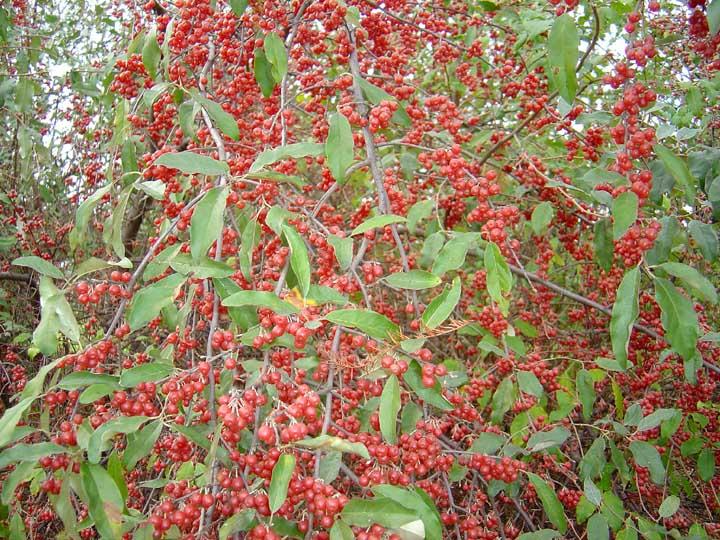
Conservationists are in a tizzy about Autumn Olive. This native of Asia was introduced here by, of all people, the state government, which 30 years ago was offering bundles of it practically free of charge. Excellent for fixing nitrogen in poor soil and prodigious at producing berries that birds love, Autumn Olive was once considered a conservationist’s delight.

Oops. Lacking natural enemies and other controls, Autumn Olive took off, and is now pushing out natives as it covers countless acres. The berries that were supposed to feed birds also often ferment, and wind up getting them drunk.

But wait! Scientists have also discovered that those berries contain up to 17 times the lycopene found in tomatoes. The anti-oxidant is said to fight cancer and heart disease. “This berry has more lycopene than any other food that we know of in the world,” said one farmer, who now harvests and sells the berries for jams and jellies. The berries also contain phytoene, beta-cryptoxanthin, alpha-cryptoxanthin, beta-carotene, and lutein – all good for your health.

So instead of mowing down Autumn Olives, maybe we should be reining them in and eating them.

Monday, August 01, 2005

Beauty and the bugs

In fields and wetlands throughout the Northeast, Galerucella calmariensis and its cousin, Galerucella pusilla, are chowing down, guests of federal and state governments.

These two European beetles were invited over to do battle with a beauty that botanists believe is a beast. The Purple Loosestrife, whose tall wands of richly colored flowers are so plentiful at this time of year, was imported more than a century ago to grace our gardens. Like many another newcomer, the plant found North America much to its liking, so much so it is now choking out native species and altering vast wetland habitats.

In Europe, Purple Loosestrife is naturally controlled by leaf-eating insects like Galerucella and probably by other plants that aren’t as easily overcome by its dense colonies. Scientists spent years studying the beetles and believe importing them will not harm any other species. Let’s hope they’re right – not everyone is convinced that introducing alien insects is wise. What’s more, beekeepers love loosestrife because of the nectar it provides at a fairly dry time of the floral year.

Odd, that a plant causing such a commotion bears a name that recalls its old use as a peacemaker.

Saturday, May 07, 2005

Barberry Dilemma

For some years environmental groups have been attacking the Japanese barberry, scheduling “pull ’em up” parties and conducting anti-barberry education programs. The prickly import that has been spreading through woodlands can push out native species.

However, the folks at the Highstead Arboretum in Redding, Connecticut, have been noticing an unusual phenomenon: Barberry bushes are sheltering native wildflowers.

Probably because the shrub is covered with thorns, deer that have been decimating many woodland plants do not eat barberry. In fact, they tend to keep away from it. As a result, arboretum staff have been finding native wildflowers that the deer normally consume, including Trout Lilies and Bloodroot, blooming away under and around barberries while the plants out in the open have been mostly eaten.

It presents a dilemma. Should we spare some of these alien invaders to protect the native flowers from the native deer?

Monday, May 02, 2005

Roadside vitamins

“What are all those white flowers along the road – every road?!” someone asked.

Twenty-five years ago, Garlic Mustard was an occasionally seen import that few knew. Today, the weed has spread to the point where plant conservationists are alarmed. These alien invaders are overcoming native species, and efforts have been organized to do them in. The most basic technique is to pull them up -- they have a tiny root system and are easy to yank.

But we have another suggestion: Eat them! In its native England, Garlic Mustard has long been a food. In fact, that's how it probably got here; Virginia settlers were using it by 1700. The garlicky leaves are used as vegetables and salad greens. Old World farmers found them so flavorful, they filled sandwiches with them.

What’s more, this tasty pest is good for you. Garlic Mustard leaves have more than twice the vitamin A of spinach and 20 times more than tomatoes. They also have nearly four times the vitamin C of oranges and nine times that of tomatoes.

So why waste a good weed?

  The Jeremiah Bennett Clan: T he Days of the Desperados One morning in 1876, a Ridgefield man was sitting in a dining room of a Philadelphi...