Tuesday, November 29, 2005

Happy Holy Days

December is another of those misnamed months, remnants of an ancient Roman calendar that split the year into 10 parts and placed December last. The name is from the Latin for “tenth month,” though, of course, it is the twelfth.

Although just about every modern Western tongue has adopted variations of December in their calendars (Dezember, Diciembre, Décembre, Dicembre, Dezembro, etc.), earlier cultures were more accurate in how they named the month. The ancient Saxons, for instance, called it Winter-monat, or Winter Month, for the season of cold begins at the solstice.

When the Saxons were converted to Christianity, they converted the name to Heligh-Monat, or Holy Month, because the birthday of Jesus Christ is celebrated near its end.

“Holy Month” was never combined into Holimonth. However, Holy Day was. Our word Holiday is nothing but a joining of Holy and Day, and thus saying “Happy Holidays” is really saying, “Happy Holy Days.”

And since December has holiness to more than one faith on more than one day, isn’t that appropriate?

Tuesday, November 22, 2005

An older tradition

Seasons may be known by their scents, but for many of us, the smell that was autumn is gone. Thirty years ago, pollution-fighting laws banned the burning of leaves, which had been almost as much a fall family tradition as Thanksgiving.

However, the ban taught many of us that the leaf smoke's heady aroma was really a waste. Piled out back, turned occasionally, and maybe even mixed with coffee grounds and vegetable scraps, leaves become wonderfully rich food for our gardens and lawns. Composting became more common.

But the law did not ban the burning of brush, the twigs and branches that the wind and we prune from the trees. Perhaps it should have.

Brush piles have a different natural benefit. They attract birds, creating a safe haven from hawks, cats and other predators. Some birds nest in them. And as it slowly rots the brush attracts wood-eating insects that many birds relish. That pile of branches can feed and shelter scores of birds while slowly returning the vegetation to the earth.

Thus, what we used to burn can instead enrich the soil as well as feed and protect wildlife. It happens naturally, the way that was “traditional” for the eons before man.

Tuesday, November 15, 2005

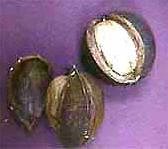
Pignuts

This is the season for gathering pignuts.

What nuts?

The pignut is the fruit of the pignut hickory, a common tree that grows 90 or so feet high. A century or three ago, some people collected and ate the somewhat bitter meats of pignuts, though most people ignored them as food. Instead, as the name suggests, many a thrifty farmer would collect them to feed to his stock.

However, not everyone cast pignuts before swine. “I am partial to the peculiar and wholesome sweetness of a nut, and I think that some time is profitably spent every autumn in gathering even such as our pignuts,” Henry David Thoreau wrote in his diary one November. “Some of them are a very sizeable, rich looking and palatable fruit.”

“How can we expect to understand nature unless we accept like children these her smallest gifts, valuing them more as her gifts than for their intrinsic value.”

Alas, encouraging the eating of pignuts is too much to ask today. Besides being bitter, the kernel is up to 80% fat, and offers few vitamins or minerals.

The farmers were probably right.

Tuesday, November 08, 2005

Wow!

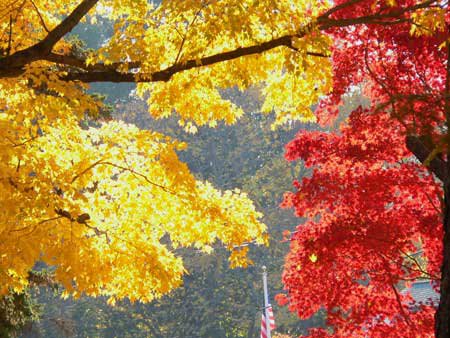
As another season of nature’s amazing treetop displays ends, we may ask “why all the color”?

Scientists know the reason leaves turn such bright colors each autumn. Several pigments, embedded in the leaf all season, have been playing second fiddle to the green chlorophyll. But now that the dying leaf no longer needs this food-producing chemical, chlorophyll fades from the scene, leaving the pigments to show off brilliant reds, yellows, oranges, and purples.

But why? Why would a tree put on such a display?

Scientists simply don’t know. As far as they can tell, a tree gains no known benefit from its autumn colors.

There is a benefit, but probably not evolutionary or measurable by scientists. The magnificence of the fall colors adds the poetic to the practical in our appreciation of these marvelous plants. Deciduous trees feed us with their fruits, shade us with their leaves, manufacture oxygen for us to breath, and hold our earth together with their roots. And just as an aside, they wow us with their brilliance each fall.

Makes it pretty tough to cut one down, doesn’t it?

Tuesday, October 25, 2005

Daylight Saving thieves

The morning people are about to exact their revenge.

Each April, Daylight Saving Time steals an hour from their favorite part of the day. On Sunday at 2 a.m., when we revert to Eastern Standard Time, the morning people will gain back that lost hour. The sun that broke the horizon around 7:10 Saturday will do it about 6:10 Sunday.

Alas, the gain will be fleeting. As the days slowly shorten, that extra hour of lightness will wane. By the Winter Solstice on Dec. 21, sunrise will be at 7:10 again.

But, say the ever-optimistic morning people, the Winter Solstice marks when we begin winning back bits of the morning. By March 7, sunrise will be at 6:10 again, and by April 2, the day before the Daylight Saving thieves return, dawn will break around 5:20. So the next day, when sunrise is at 6:20, the morning-lovers have lost only 10 minutes from the 6:10 they celebrate this Sunday.

Crazy thinking? Perhaps. But, as evening people say, that's the way morning people are.

Tuesday, October 18, 2005

The pill on a plant

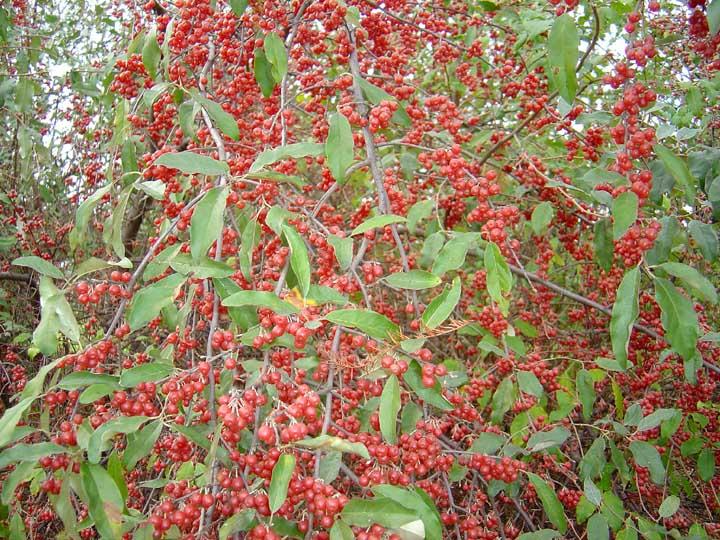
Conservationists are in a tizzy about Autumn Olive. This native of Asia was introduced here by, of all people, the state government, which 30 years ago was offering bundles of it practically free of charge. Excellent for fixing nitrogen in poor soil and prodigious at producing berries that birds love, Autumn Olive was once considered a conservationist’s delight.

Oops. Lacking natural enemies and other controls, Autumn Olive took off, and is now pushing out natives as it covers countless acres. The berries that were supposed to feed birds also often ferment, and wind up getting them drunk.

But wait! Scientists have also discovered that those berries contain up to 17 times the lycopene found in tomatoes. The anti-oxidant is said to fight cancer and heart disease. “This berry has more lycopene than any other food that we know of in the world,” said one farmer, who now harvests and sells the berries for jams and jellies. The berries also contain phytoene, beta-cryptoxanthin, alpha-cryptoxanthin, beta-carotene, and lutein – all good for your health.

So instead of mowing down Autumn Olives, maybe we should be reining them in and eating them.

Tuesday, October 11, 2005

50 years ago…

Nature seems know. With day after day of showers and downpours, she must be celebrating the 50th anniversary of her big 1955 show when nearly 14 inches of rain fell on an already water-logged town - a three-month supply in three days. The result was the worst flood our area experienced in the 20th Century.

The flood of ’55washed away roads and bridges, destroyed homes, damaged factories, and killed three people. It also opened eyes. A new kind of care was needed in dealing with the land.

In the past half-century, flood zones and regulations restricting development in them have been adopted. The state has purchased many hundreds of acres to preserve natural “sponges” like swamps and pond watersheds. The Army Corps of Engineers has built a flood dam in Ridgefield, and plans others.

Much has been done, and 14 inches of rain might not do the damage today it did in 1955. But we should never be complacent; continued care, control measures and even an early-warning system are necessary.

After all, New Orleans thought the dikes would hold.

  The Jeremiah Bennett Clan: T he Days of the Desperados One morning in 1876, a Ridgefield man was sitting in a dining room of a Philadelphi...