Tuesday, August 29, 2006

The embattled beaver

Pity the poor beaver. Although touted in countless film documentaries, the beaver’s industriousness is always getting the rodent into trouble.
To establish ponded homesteads, beavers kill trees to build dams. The dams often flood roads, lawns, septic systems, parking lots, basements, and other trappings of suburbia, angering the human neighbors.
It wasn’t always so. Driven from much of the East Coast by farmers who chopped down most of the trees, beavers had vanished in many areas by the 19th Century. With the return of woodlands in the 20th Century, various reintroduction efforts were successful – so successful in Connecticut that some 8,000 beaver live in that small state today.
Adult beavers have no natural enemies – except man. They are among the few creatures legally hunted with what are called “kill traps.” Amazingly, kill traps are the only legal way to catch them in Connecticut; it is illegal to live trap a beaver to relocate it. The official state explanation: There are so many beavers in Connecticut that moving them would only exacerbate problems elsewhere.
Being industrious and a movie star doesn’t always pay.

Wednesday, August 23, 2006

Hitchhiking hummers

Nature inspires much lore. Dragonflies sew up your mouth. Toads give you warts. Bats land in your hair.

But a magazine, not children or backwoods naturalists, dreamed up a tale about hummingbirds, those hovering micro-birds that just now getting ready to return to Central America. In the 1880s, a writer proposed that Ruby-throated Hummingbirds, which weigh only an eighth of an ounce, couldn't possibly fly non-stop across the Caribbean on their way to and from North America. Without any evidence in hand, he theorized they hitchhiked on the backs of such larger birds as Canada Geese.

Today, we know this is not true, yet the speculation has been told and retold till many consider it fact. But as is often the case in nature, fact is more amazing than fiction. Rather than hitchhike, this miniature creature, wings whizzing at 80 beats per second, zips non-stop across 1,000 miles of open sea at up to 40 miles per hour, twice a year.

Even more amazing is its metabolism. If you weighed 170 pounds and lived like a hummingbird, you'd burn 150,000 calories a day and produce 100 pounds of sweat. And if you ran out of water, your skin temperature would surpass the melting point of lead and you'd probably catch fire.

Tuesday, August 22, 2006

Summer's ghosts

Coming across a cluster of Indian Pipes is an eerie, almost shocking experience. Ghostly and pale in the dark of a midsummer woods, the plant’s freakish white flesh makes it look more like an oddly formed fungus than the wildflower it is.

Indians Pipes are not only strange-looking but strange acting. Botanists are not certain how they survive. At first, they were thought to be parasitic – living directly off other live plants. Then they were deemed saprophytic – living off dead plants. The latest thinking, however, is that they are “epiparasite” – a parasite that forms a relationship with another parasite to get food from a host. In this case, a fungus connects the roots of the Indian Pipe to a nearby plant, transmitting essential nutrients.

That’s why the pipe is white and leafless. It doesn’t need chlorophyll for photosynthesis, and it doesn’t need leaves, the food factories for most plants.

And that’s also why, when most of summer’s flowers are aglow in the fields, you’ll find Indian Pipe hiding in the shadows, deep in the woods.

Tuesday, August 08, 2006

Crawling mysteries

Those who’ve grown up in suburbia don’t usually think of it as mysterious. Yet even our backyards are filled with mystery.
Take the caterpillar, for example. Stroll in your yard and you could quickly spot half a dozen kinds. Spend a little time, and you might find dozens.
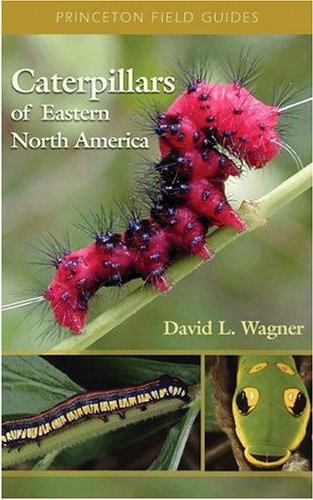
But discovering caterpillars is a lot easier than naming them – or knowing what butterfly they become. And in a world that offers field guides to bird nests, mammal scat, and even roadkill, it’s surprising to learn that someone – in our backyard, almost – has recently written the first caterpillar field guide. UConn Professor David Wagner and his book, Caterpillars of Eastern North America, were profiled in the Aug. 8 New York Times.
Backyard caterpillar study has its advantages. The creatures can’t run or fly away, and you can, with little effort, raise most into their adult forms. You might even contribute to science since, as Dr. Wagner points out, there are moths – including well-known ones – whose caterpillars have never been discovered. It’s great fare for a natural history detective.

Tuesday, August 01, 2006

Queen’s mystery

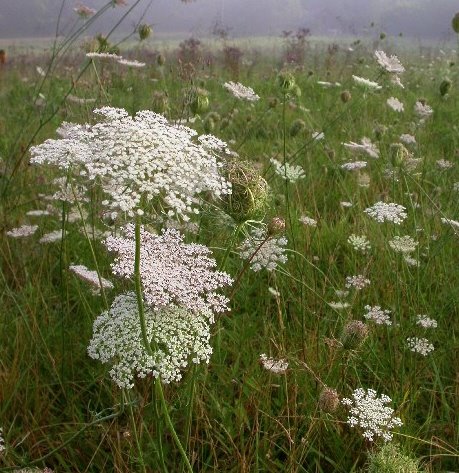
Each August, a blizzard of white covers many fields and roadsides as Queen Anne’s Lace opens its flowers, and offers its annual mystery.

Look at the cluster of hundreds of tiny white florets. Right around the middle, you’re apt to spot one little purple flower. Why is there a single, colored floret in a sea of white? No one knows for sure, except the folklorist. Long ago, the story was told to children that Queen Anne pricked her finger as she was stitching some lace, and the purple flower is her bloodstain passed down the centuries.

Less mysterious is the plant’s ties with man. Pull one up and smell the root. Its scent is a clear give-away. Called by the scientist Daucus carota, Queen Anne’s Lace is an ancestor of our garden carrot. In its native England, where the wounded Queen Anne lived, it is known simply as Wild Carrot.

Tuesday, July 25, 2006

Brrrr? Achoo?

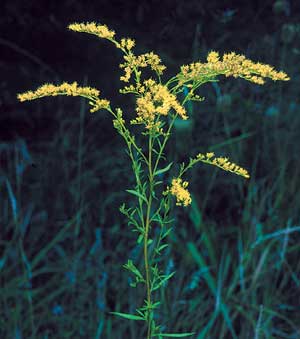
The temperature might be 95 degrees on a July day, but the sight of its yellow blossoms can offer a chill that’s autumnal.

New Englanders used to say Early Goldenrod’s appearance presaged an early winter, but as its name suggests, this species always blooms in July.

Early Goldenrod is just one of nearly 50 kinds of goldenrods found in the Northeast, most blooming in late summer and fall. All are subject of another, more serious misconception: They are said to cause hay fever.

It’s simply not true. Goldenrods bear colorful flowers that attract insects. Their pollen grains, designed to be carried by bees, are too big to become airborne and to end up in the noses of allergy sufferers.

The real villains are grasses, plantains and ragweeds, which bear green flowers and dispatch their tiny pollen into the air. In fact, any time you see a colorful flower, you can bet the display is aimed at attracting bees and that the pollen is too big to bug you.

It’s the unnoticed, dull, green flowers that create the season for sneezin’.

Tuesday, July 04, 2006

Scent of summer

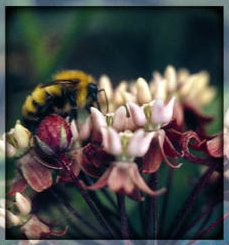
There’s nothing elegant about the look of milkweed. In fact, to most people, it is what its name suggests: A weed. But get close to a cluster of its unusual flowers and you may be charmed.

Few native wildflowers smell as sweet as common milkweed. The plant uses its powerful scent to attract bees, which provide pollination like Pony Express riders. As they crawl across the blossoms, their legs unwittingly pick up tiny saddlebag-shaped pollen packages to deliver from one flower to another.

The result of pollination are those late-summer packages of fluff that delight children and which the Navy once used to fill life vests.

For us, however, milkweed is a room freshener. Somewhat drab and droopy, the flowers are not the stuff of fancy bouquets. But pick a stalk – don’t mind the sticky juice, from which Thomas Edison once tried to make rubber – put it in water, and place it in a dark corner of a room where it will stand unseen but not unnoticed as it sweetens the air with its fresh summery scent.

  The Jeremiah Bennett Clan: T he Days of the Desperados One morning in 1876, a Ridgefield man was sitting in a dining room of a Philadelphi...