Monday, October 30, 2006

Birds at night

Where do birds go at night – especially in the winter?

When heading off to sleep, birds are looking for protection from two things: enemies and the elements. Because of this – and, of course, the fact that it’s dark out – people rarely see sleeping birds.
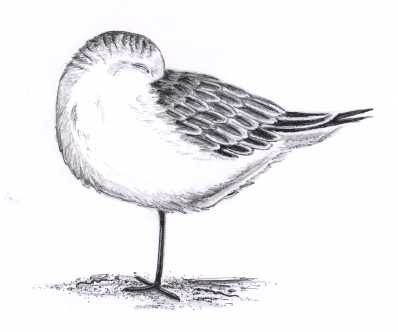
Diurnal birds – those active in the daytime – have various ways of spending the night. Many small songbirds simply find a branch in a convenient tree to protect themselves from wind, rain and snow. Some favor thick bushes and shrubs. Many like spruces, hemlocks and other evergreens whose needles provide a degree of year-round protection. Cavity dwellers, such as woodpeckers and wrens, may make use of holes in trees or among rocks or fallen trees.

Outside breeding season, many songbirds such as robins, bluebirds and even cardinals will gather in flocks and sleep together. Some birds, such as crows, vultures, and starlings, will roost in great numbers. Roosts provide protection in numbers as well as a modicum of heat generated by all the bodies being fairly close together.

Gull, ducks and geese will float on water at night, usually in groups, while some shorebirds will settle down for the night on a relatively remote beach or in grass at the edge of the shore.

Some birds, such as Common Redpolls, ptarmigans and Ruffed Grouse, will bury themselves in snow at night, taking advantage of its insulating quality. It was a technique emulated by North American Indians as they journeyed away from camp in winter.

Tuesday, October 17, 2006

Fishing for cats

A century ago our suburban countryside was largely farmers’ fields, a moonscape compared to today. Now, the trees have returned, and with them, some woodland creatures that haven’t been seen since before the colonists flattened the forests primeval.

A case in point is the fisher. This 10- to 15-pound marten has long been found in northern New England and forested regions across North America. But until a few years ago, these weasel-like mammals were unknown here. Now that the trees are back, so are the fishers.

Sometimes called fisher cats, fishers neither fish nor are they even closely related to cats. In fact, they may be a cat’s worst enemy. Fishers usually feed on wild mammals ranging from mice and voles to porcupines and young deer. In suburbia, however, domestic cats are becoming a fisher delicacy. And there’s little a hapless cat can do – run up a tree and the arboreal fisher will follow right behind.

It’s another good reason why all pet cats should be house cats.

Tuesday, October 10, 2006

Eat a sheep’s nose

Nothing gives more, yet asks less in return, than a tree, particularly the apple,” said Jonathan Chapman. Better known as Johnny Appleseed, Chapman spent a half-century promoting the apple's many gifts. Besides providing flowers in the spring and shade in the summer, the tree gives us fruit in the fall. Countless dishes – from pies and cakes to sauces and butters – are made from apples. We can drink its juice and, if we age it a bit, tipple its hard cider.

The fruit is tasty and nutritious, full of fiber. It comes in a perfect package: attractive, long-lasting, and 100% biodegradable.

More than 2,000 apple varieties were once grown in the United States, offering a huge variety of flavors, as well as textures, colors, picking times, and durability. Apples names like Westfield, York imperial, black gilliflower, Baker, Newtown pippin, Stayman, and Esopus Spitzenburg were once commonplace. Today we’re lucky to find a half-dozen kinds in a supermarket and a dozen at an orchard.

However, “antiques” are still around and if you’re out for a ride in rural America, watch for an orchard carrying Dutchess of Oldenburg, opalescent, Ashmeads kernel, or even sheep’s nose. Buy a bag and taste Americas yesterday.

Tuesday, October 03, 2006

The survivalists

The season of migration is well underway as millions of birds flee the coming cold.

Their journeys often amaze us with their length and navigational expertise. The Arctic Tern flies 11,000 miles from northern Canada to Antarctica each fall. The hummingbird, weighing but a fraction of an ounce, may traverse a thousand miles of the Gulf of Mexico to reach winter grounds. Many songbirds fly hundreds of miles each night, guided only by stars or some invisible magnetic field.

Amazing all. But what of the birds that choose to stay? Are they just lazy? Hardly.

While their migrating brethren are enjoying temperate shores and tropical forests, our year-round birds face cold and snow. They must survive winter’s winds and frigid temperatures. They must find sustenance when a foot or more of snow covers the ground. Many must spend months in preparation, storing food for winter use – and later remembering the hundreds of caches they made.

Whether they are winging their way to warmth, or just crouching against the cold, birds are astounding survivalists.

Saturday, September 30, 2006

Scents of the seasons

The seasons have their own smells, distinctive scents in the air that are as tell-tale of time as the vegetation on the ground.

Spring arrives with a sour-sweet smell that arises from the brooks and swamps as soon as the snow melts. It comes from the rotted leaves and roots of last year’s plants that will feed this year’s growth.

Flowers appear, and you can almost tell the part of the month by the fragrances – the early Andromeda, tulip trees, magnolias, mustards, lilacs, and rockets. Like the season, they are fresh, sweet, celebrating rebirth. Then come the rich, heady scents of summer – the wild roses, clovers, milkweeds, pokeweed, and Queen Anne's lace. As summer wanes into fall, the goldenrods and Joe-Pye weeds begin filling the air with spice – scents of anise and vanilla.

And then the leaves begin to fall, offering an earthy but pleasant aroma of decay, only to be covered with the snow. Snow has a scent of its own and its coming on the wind is easily forecast with a good sniff.

The scents of the seasons are a calendar for the nose. Enjoy the latest page!

Tuesday, September 26, 2006

A kick and a puff

Ages before video games or even Lego and Erector sets, children often entertained themselves with the toys of nature. In early autumn, a favorite was the Giant Puffball, a magical fungus that can reach massive proportions – in the world of fungi, at least. Specimens measuring six feet across and weighing more than 40 pounds have been found.

For a kid in the 18th or 19th Century, a big, white puffball sprouting in a pasture was just too tempting to ignore. Perhaps presaging their descendants’ interest in football and soccer, youngsters would invariably give the “ball” a good, swift kick. The reward was the namesake puff: A thick cloud of more than a trillion spores could burst from a ripe puffball.

The kicker probably did the fungus a favor, for the spores are its seeds and the kick cast the fate of future generations to the wind. Odds of success for a microscopic spore are slim, however, for its chances of creating a new Giant Puffball are literally one in billions.

Tuesday, September 19, 2006

Bounty from above

They say that tall oaks from little acorns grow. Judging from this year’s acorn supply, the region will be well-forested in the future.

Oaks occasionally generate bountiful acorn crops – and many years, produce not a nut. Last spring apparently offered ideal conditions for pollinating oak flowers – dry, warm weather.

Of course, most of this year’s bumper crop will be consumed – by nearly 100 kinds of birds and mammals. For creatures as small as a nuthatch or a mouse and as large as a bear and a deer, acorns are a major source of food in the fall. The ebb and flow of populations of such common creatures as Gray Squirrels and Blue Jays are closely related to acorn yields.

With so many fans in nature, you’d think humans would be acorn-eaters, too. In fact, they once were: American Indians and early settlers ate acorns. Today, however, we’ve been spoiled by the sweeter meats of peanuts, cashews, almonds, and other nuts that are also easier to process – and to salt.

  The Jeremiah Bennett Clan: T he Days of the Desperados One morning in 1876, a Ridgefield man was sitting in a dining room of a Philadelphi...