Tuesday, February 20, 2007

The hungry hawk

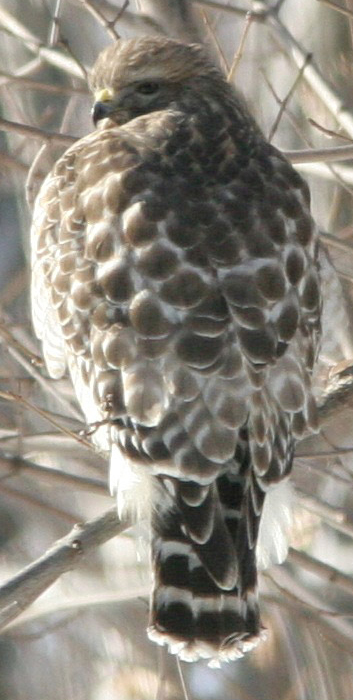
As the compiler of a column called BirdNotes, I regularly get reports of hungry hawks knocking off backyard birds – one once even tried to fly through a pet store window to dine on a budgie. (He was unsuccessful.)

Winter is the best hunting season for year-round hawks. The trees are free of leaves and dinner is out in the open, ready for the plucking. For the same reason, winter is the best time to witness “bird hawks” in action.

Often hawks will be seen perched near a backyard birdfeeder. People sometimes feel guilty when they watch a hawk capture a bird attracted to their feeders. Don’t. If the hawk hadn’t gotten its meal at your feeder, it would have found it in another yard or field. Your feeder just makes it a tad more convenient for nature to take its course.

After all, like it or not, it’s a bird-eat-bird world out there.

Friday, February 16, 2007

Fisher food

In recent years townspeople have reported sighting fishers, the 10- to 15-pound weasel-like martens that have been making a recovery in the region.

Their appearance is no accident. In 1988, the Connecticut Department of Environmental Protection bought a bunch of live-trapped fishers from upper New England, and released them in western Connecticut. The aim was to restore an animal that had once been native to the state, but had been driven away by the agricultural deforestation and perhaps overtrapping. Today, fishers are found throughout the state and are doing so well, licensed trapping is allowed in the fall.

While fishers don’t fish – or even eat fish, they do love a tasty porcupine. That thorny fare is in rather short supply, however, so they have turned to a more abundant mammal for food: The squirrel.

In fact, in northern Vermont and New Hampshire, where the fisher was never extirpated, squirrels are much less common than they are here. The natives say it’s because the fishers keep them under control – good news for anyone who’s ever had squirrels invade their home.

Tuesday, February 06, 2007

Cool sweets

If you have a sweet tooth, the cold snap is a boon. At least two weeks of freezing nights are needed for our maples to produce a good flow of late-winter sap, the source of America’s oldest breakfast condiment.

The warmth of first month of winter was beginning to make the sap tappers nervous. And there are plenty of maple harvesters around: little Connecticut ranks 10th in the United States in its maple syrup production – some 11,000 gallons annually.

The American Indians were the first to recognize the treat offered by maple sap, boiled down to its syrupy or solid essences. But it is only recently that scientists have found that this sweetener is actually good for you. A single teaspoon contains nearly a quarter of your daily need of manganese and plus a good dose of zinc to boot. Both minerals are important ingredients in the body’s antioxidant defenses.

So our maples not only provide sweet treats, plus shade, oxygen, and terrific fall colors, they also contribute to our good health.

Tuesday, January 30, 2007

Hoop poles

Mention a “hoop pole” today and you might inspire images of basketball or tent supports. A century or two ago, however, hoop poles were a well-known and valuable commodity that many local farmers harvested from the wild to earn extra cash.

Hoop poles were long, straight rods, cut in the woods from ash, hickory, hazel, and white oak saplings or from bushes that had been specially pruned for the purpose. While they might be cut in spring or fall, farmers often processed them in midwinter, when they were less busy. Bark and shoots, for instance, had to be removed.

The poles were used around the farm for many tasks such as rollers for moving heavy loads and for temporary floors under haystacks. They were also split to make barrel hoops and basket-weaving material; the poles were hammered to flatten them, soaked in water, and then split into the hoops that held the barrel staves together.

Perhaps the oddest use for hoop poles, however, was as stiffeners in the colossal, but fashionable skirts women sometimes wore in the 19th Century.

Tuesday, January 23, 2007

Role of roads

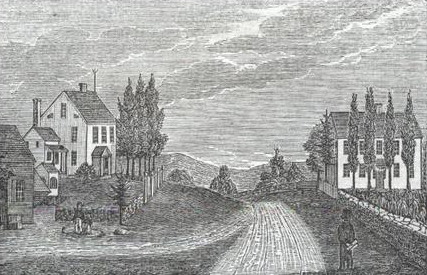
From the earliest days of our communities, highways were of great importance, but for much different reasons than they are today. The role of roads has changed significantly in the past century or so.

Two hundred ago, roads were chiefly lines of communication. They connected homestead with homestead, families with town and church, and towns with towns. There were no telephones, no radio, no television, no Internet, and no local newspapers. News traveled mostly by word of mouth, and mouths traveled over roads.

In those days work kept most people at home, not away from it. The farm was their occupation and their chief source of food and clothing. Today, work is often far from home and supplies are in town or the nearby city, all reachable by highways. News, on the other hand, arrives with the flick of a switch, the opening of a mailbox, the toss of a paper carrier, or the ring of a telephone.

In many ways, a road of old was like a wire of today.

Wednesday, January 17, 2007

Uncomfortable cold

Temperatures have dipped into the teens, and ice is forming on ponds. Yes, we’re finally feeling cold.

What we’re feeling, though, is nothing like what folks used to feel.

The people who settled New England experienced cold as you would never want to. In January and February, frigid air was a 24/7 phenomenon inside most houses, which were inefficiently heated and poorly insulated.

Until the arrival of central heating in the late 19th Century, houses were often iceboxes in winter. It was not unusual to have the water in the house turn to ice overnight and to have snow leak through windows and stay frozen on the floor. Frostbite was a problem not only outside, but indoors, where bedroom temperatures could approach zero. And let’s not even think of what outhouses were like.

So as your nose and fingers tingle and your breath freezes in front of you when you leave your well-heated home, take a moment to remember those hardy people who came before us and who knew few comforts at this time of year.

Tuesday, January 09, 2007

Bunny blues

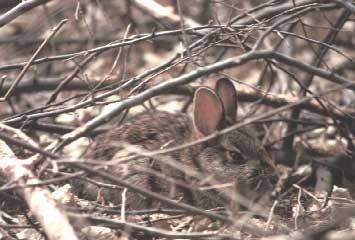
Pity the poor New England Cottontail: It’s disappearing from its namesake.

The only native rabbit in southern Connecticut, the New England Cottontail was once widespread from southeastern New York to Maine. Today, studies by Connecticut and New Hampshire biologists are finding so few that this bunny has become a candidate for the federal Endangered Species List.

Several forces are working against the New England Cottontail. The thickets it lives in are disappearing, thanks to both man-made and natural changes. Its food is being gobbled up by deer and by the alien Eastern Cottontail, the rabbit we see all the time. Introduced a century ago by hunters seeking new game, the Eastern Cottontail is more adaptable to suburbanization.

There’s also the growing number of hawks, owls, coyotes, foxes, and even fishers, for whom rabbit is fine fare.

If all that isn’t bad enough, the New England Cottontail suffers from an identity crisis. It looks so much like an Eastern Cottontail that DNA samples are often needed to confirm that it’s native, not alien.

So even if you see one close-up, it’s tough to tell the rabbit is rare.

  The Jeremiah Bennett Clan: T he Days of the Desperados One morning in 1876, a Ridgefield man was sitting in a dining room of a Philadelphi...