Thursday, March 29, 2007

Supply and demand

Day and night, the sky is alive with life. Migration has begun, and literally millions birds are silently streaming northward in search of nesting grounds.

Only a fraction of these travelers are seen locally, however. They pass by high overhead, often in the middle of the night. Most don’t stop and those that do may pay only brief visits or spend the time sleeping. Sometimes, though, they make forced landings. Countless Fox Sparrows were grounded by the recent nor’easter, showing up in flocks at feeders where they had never been seen before, and generating a flurry of excitement in the bird-watching world – even inspiring some newspaper stories.

All these northbound birds are heading for territory that is barren in winter, but lush with food, both insects and vegetation, in spring and summer. What’s more, the northlands offer virtually unlimited nesting sites – unlike the crowded winter grounds of the South or the tropics.

Thus, migration is nature’s efficient way of handling life’s supply and demand.

Thursday, March 22, 2007

Spring ephemerals

Ah, spring, the season of new and renewed life! It’s a time when many nature lovers turn their eyes skyward to spot migrating birds as signs of the season. Others, however, head for the woods and look to the ground. They seek the “spring ephemerals,” March and April wildflowers that pop up, bloom, fruit, and disappear before most of the trees have unfurled their leaves.

Ephemerals like bloodroot, trout-lily, trillium, anemone, and spring-beauty have to deal with wintry winds, frosty nights, even snow and ice. But there are benefits to their lifestyle. The ground is wet with snow melt and the trees have not yet begun to compete for the water. Plenty of nutrients from last year’s dead leaves have leached into the soil. And there’s much light because tree leaves have yet to shade the forest floor.

Unfortunately, overpopulating deer, ravenous after a long winter, find most ephemerals irresistible. And a plant eaten soon after it sprouts cannot make and store food in its roots so it can reappear next year, and cannot produce seeds for future generations.

Thus, in many woods, ephemerals have become invisibles.

Friday, March 16, 2007

Pain relief

An amazing thing about the Pussy Willow is its color – or more specifically, the lack of it. Few shades are duller than gray, yet the flowers of the Pussy Willow are among the most beloved of any spring bloom.

Therein lies its charm. This bush wins us with form, not flash. Its catkins are catlike, all cute and furry like the tail of a kitten, and they wrap themselves along the branches like so many fuzzy caterpillars marching to the sky.

It also wins us with timing, blooming with the first thaws of March. But for those in a hurry for signs of spring, snipping off a few bloomless branches and sticking them in water will net wands of premature catkins.

The wonders of the willow were known to Hippocrates in ancient Greece and to North American Indians. However, both were interested not in the flowers, but the bark, which produced a painkiller called salicin. This, in turn, led to the discovery of salicylic acid, and to synthesizing acetylsalicylic acid – what we call aspirin.

So, it seems that Pussy Willows can relieve a lot more than just the bleakness of winter.

Tuesday, February 20, 2007

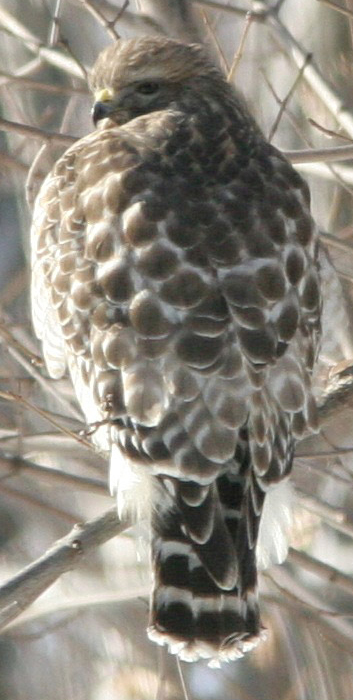
The hungry hawk

As the compiler of a column called BirdNotes, I regularly get reports of hungry hawks knocking off backyard birds – one once even tried to fly through a pet store window to dine on a budgie. (He was unsuccessful.)

Winter is the best hunting season for year-round hawks. The trees are free of leaves and dinner is out in the open, ready for the plucking. For the same reason, winter is the best time to witness “bird hawks” in action.

Often hawks will be seen perched near a backyard birdfeeder. People sometimes feel guilty when they watch a hawk capture a bird attracted to their feeders. Don’t. If the hawk hadn’t gotten its meal at your feeder, it would have found it in another yard or field. Your feeder just makes it a tad more convenient for nature to take its course.

After all, like it or not, it’s a bird-eat-bird world out there.

Friday, February 16, 2007

Fisher food

In recent years townspeople have reported sighting fishers, the 10- to 15-pound weasel-like martens that have been making a recovery in the region.

Their appearance is no accident. In 1988, the Connecticut Department of Environmental Protection bought a bunch of live-trapped fishers from upper New England, and released them in western Connecticut. The aim was to restore an animal that had once been native to the state, but had been driven away by the agricultural deforestation and perhaps overtrapping. Today, fishers are found throughout the state and are doing so well, licensed trapping is allowed in the fall.

While fishers don’t fish – or even eat fish, they do love a tasty porcupine. That thorny fare is in rather short supply, however, so they have turned to a more abundant mammal for food: The squirrel.

In fact, in northern Vermont and New Hampshire, where the fisher was never extirpated, squirrels are much less common than they are here. The natives say it’s because the fishers keep them under control – good news for anyone who’s ever had squirrels invade their home.

Tuesday, February 06, 2007

Cool sweets

If you have a sweet tooth, the cold snap is a boon. At least two weeks of freezing nights are needed for our maples to produce a good flow of late-winter sap, the source of America’s oldest breakfast condiment.

The warmth of first month of winter was beginning to make the sap tappers nervous. And there are plenty of maple harvesters around: little Connecticut ranks 10th in the United States in its maple syrup production – some 11,000 gallons annually.

The American Indians were the first to recognize the treat offered by maple sap, boiled down to its syrupy or solid essences. But it is only recently that scientists have found that this sweetener is actually good for you. A single teaspoon contains nearly a quarter of your daily need of manganese and plus a good dose of zinc to boot. Both minerals are important ingredients in the body’s antioxidant defenses.

So our maples not only provide sweet treats, plus shade, oxygen, and terrific fall colors, they also contribute to our good health.

Tuesday, January 30, 2007

Hoop poles

Mention a “hoop pole” today and you might inspire images of basketball or tent supports. A century or two ago, however, hoop poles were a well-known and valuable commodity that many local farmers harvested from the wild to earn extra cash.

Hoop poles were long, straight rods, cut in the woods from ash, hickory, hazel, and white oak saplings or from bushes that had been specially pruned for the purpose. While they might be cut in spring or fall, farmers often processed them in midwinter, when they were less busy. Bark and shoots, for instance, had to be removed.

The poles were used around the farm for many tasks such as rollers for moving heavy loads and for temporary floors under haystacks. They were also split to make barrel hoops and basket-weaving material; the poles were hammered to flatten them, soaked in water, and then split into the hoops that held the barrel staves together.

Perhaps the oddest use for hoop poles, however, was as stiffeners in the colossal, but fashionable skirts women sometimes wore in the 19th Century.

  The Jeremiah Bennett Clan: T he Days of the Desperados One morning in 1876, a Ridgefield man was sitting in a dining room of a Philadelphi...