Showing posts with label months. Show all posts

Monday, April 21, 2014

April’s origin

April has had a bad time of it. Songs bemoan its showers, a poet calls it the “cruelest month,” its length has been cut, and its first day is for fools. Even the origin of its name is uncertain.

In the early Alban calendar, April was the longest month, with 36 days. Various Roman emperors fiddled with its size until Julius Caesar chose the 30 days that stuck. Because April is the time when trees and flowers come to life, many scholars believe its name came from the Latin, aperire, which means “to open.”

Others have pooh-poohed this idea, pointing out that no other month has been named for a condition of nature. Instead, they say, the likely source is a goddess.

These scholars, steeped in dusty mythology of ancient Greece and Rome, maintain that the Romans dedicated this month to Venus, the goddess of love, because April is the month when nature begins its myriad methods of reproduction. The Greek for Venus was Aphrodite, and, the scholars say, that is the root of the name – from Aphrodite to Aphrilis to Aprilis to our April.

Aperire seems so much simpler and more reasonable.

Saturday, March 01, 2014

Old Number One

March isn’t what it used to be. Oh, sure, it’s the only month with a command – March 4th – and yes, it was named for a commanding god. But March used to be Number One.
Mars, relaxing
Early calendar designers in the Northern Hemisphere were logical. March is the month of spring’s arrival, the time when life returns to the earth – a reasonable place to begin a new year. So the Romans made March the first month. So did the Saxons, who called it Lenet Monat, or length month, referring to the longer days. Even until 1752, the British considered March 26 the beginning of the legal year.
Since the month was so important, the Romans named it after a leading deity, Mars, their god of war. The Romans were, after all, a militaristic nation, conquerors of much of Europe.
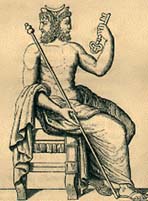
Alas, the reshuffled modern-day calendar gives us a leading month, in the dead of winter, that’s named for Janus, the god of doors. Yes, doors.
Let’s face it: The whole year isn’t what it used to be.

Sunday, July 08, 2007

July’s power

July is the month when the sun is strongest. In our neighborhood, high temperatures average 84, five degrees warmer than in June and three higher than in August.

Because the sun shows so much power in July, Mark Anthony had the month Quintilis changed to honor his late friend, Julius Caesar, a man of great power. The change also eliminated the nasty problem of the seventh month being named five, its old position in the Roman year.

The ancient Saxons were more down to earth about naming their months. July was Hay Monath, when they mowed and harvested hay, or sometimes Maed Monath, supposedly because the meads – the meadows – were in bloom then. However, mead is also an ancient alcoholic beverage made from fermented honey.

And since it’s said that mead imbues the drinker with wisdom, courage and strength, perhaps Maed Monath is the time to sit back, sip some mead, and quietly seek these admirable qualities.

Tuesday, January 10, 2006

The door

Most months have dumb names, honoring egotistical emperors and long-dead gods, or saying they are the 10th when they are the 12th. But at least January makes a statement.

Centuries before the Christian era, a king named Numa Pompilius decided the Roman world needed more months than the 10 it had. So he added two and, unlike Julius Caesar and Augustus, was modest enough to keep his name off both. The first, placed at the beginning of the year, was named for Janus, the god of doors. Yes, back then, even doors had a god.

But to old Numa, this was appropriate. January opened the door to the new year, so why not have Janus there to make sure we didn’t trip over the threshold.

And it sure beats the old Saxon name for the month. They called it Wolf-monat because that’s when wolves were the hungriest and most apt to gobble up a Saxon foolish enough to be wandering out of doors in January.

Tuesday, September 13, 2005

Time of much freshness

September is the month of summer’s last fling and winter’s first beckoning, a time when the thermometers might hit 90, yet when you could find the first frost on your lawn.

September’s average high temperature is 74, and low, 50, a range that many would consider just about ideal. But records for the past 20 years show September’s possibilities for extremes: 100 and 23 degrees. The average first frost here is around Sept. 22, the same day this year on which autumn arrives.

September has also been a dry month, averaging only 3.8 inches of rain over the past two decades, one inch less than August or July, or even November. It also has averaged fewer rainy days than any other month – just six.

While that dryness may desiccate lawns and strain wells, September’s weather is about the best that our part of the world has to offer. Many sunny days that are crisp, yet mild, make for great times outdoors. No wonder the Mohawks called September’s full moon Seskhoko-wa – “time of much freshness.”

Sunday, September 04, 2005

Caesars and Saxons

September, the ninth month, is named the seventh. But it might have been called August, were it not for July.

In ancient Rome, when the year began in March, September was the seventh month and had 31 days. The emperor Augustus decided he was important enough to warrant a month to honor him, just as Julius Caesar had July named for him. Julius’s honor came posthumously, but Augustus was not about to let death rob him of enjoying his tribute.

Augustus should have picked September, his birth month, just as July was Julius’s. But Sextilis, the sixth month, was next to the month of his famous predecessor. Besides, Sextilis had been a lucky month for him, so he renamed it instead. But Augustus didn’t want only 30 days when Julius had 31, so he added a day to August – and took one from September.

In naming their months, the practical and thirsty Saxons were not interested in self-aggrandizement. September was Gerst monat, the barley month, named for the crop harvested then and the chief ingredient in their favorite beverage: Beer.

Monday, August 08, 2005

August, the Eighth

Some people go out of their way to be remembered after they’ve gone. For instance, when he gave the beach to the town of Ridgefield, Conn., the late Francis D. Martin required it be named Martin Park.

But few people have succeeded at being memorialized better than Caesar Augustus, the Roman emperor. He took a month long known as Sextilis, and changed it to Augustus in his own honor. He probably did us a favor, however, since Sextilis means sixth. Augustus’s predecessor, Julius, had reformed the calendar into a 12-month affair in which Sextilis became the eighth month, and which he should have renamed October, which means eighth. But Julius had made the eighth month the 10th month, and had left its name October. Thus, we would have had two months that were eighth, even though one of them was 10th.

Caesar Augustus did something else useful. Julius had made the month 30 days instead of 29. Augustus decided that he should be the equal of Julius, honored in the previous month’s name, and he swiped a day from February to add to August.

Good move! Who wouldn’t want more August and less February?

Wednesday, June 01, 2005

June air

June, as they sing in Carousel, is busting out all over, developing May’s lushness and adding the colors of roses and rhododendrons, and the brilliance of early field flowers like daisies and fleabanes. It is the month that moves us from the rebirth of spring to the verdure of summer.

June offers close to ideal weather, with an average high of 79 degrees and an average low of 56. At 71 and 47, May is just a tad too cool for those of us anxious to dive into summer’s warmth.

June’s name fools many people who think it commemorates a Roman god. In fact, June is short for a Junioribus, the lower or junior house of the old Roman legislature. May recalls the upper house, a Majoribus.

Perhaps the timing of the names involves an ancient political joke about lower-house oratory. June is the warmer month, after all, and offers more hot air than May. In modern Junes, we offer our own version of hot air: graduation speeches galore.

  The Jeremiah Bennett Clan: T he Days of the Desperados One morning in 1876, a Ridgefield man was sitting in a dining room of a Philadelphi...