Profiles of notable Ridgefield, Connecticut, people of the past, along with musings on nature in suburbia and meanderings into The Old Days.
Follow us on Facebook's "Old Ridgefield" group or at www.RidgefieldHistory.com
Wednesday, October 12, 2016
Monday, March 10, 2014
Wings and water
As soon as the ice and snow begin to thaw, insects such as carrion-eating flies start to appear in the air and others emerge in the water. Fish, once protected by ice, become exposed, and amphibians like salamanders and spring peepers crawl out of their winter beds. Plants that like wet feet become accessible in the water and begin to grow in the swamps.Wetlands also offer treats left from last season in the form of berries and seeds still held by plants like buttonbush. The bush’s aged but still tasty fruits are designed to attract the hungry migrants. The birds eat and soon “plant” the seeds, complete with fertilizer, far from the mother bush and just in time for a new growing season.
Friday, February 16, 2007
Fisher food
Their appearance is no accident. In 1988, the Connecticut Department of Environmental Protection bought a bunch of live-trapped fishers from upper New England, and released them in western Connecticut. The aim was to restore an animal that had once been native to the state, but had been driven away by the agricultural deforestation and perhaps overtrapping. Today, fishers are found throughout the state and are doing so well, licensed trapping is allowed in the fall.
While fishers don’t fish – or even eat fish, they do love a tasty porcupine. That thorny fare is in rather short supply, however, so they have turned to a more abundant mammal for food: The squirrel.
In fact, in northern Vermont and New Hampshire, where the fisher was never extirpated, squirrels are much less common than they are here. The natives say it’s because the fishers keep them under control – good news for anyone who’s ever had squirrels invade their home.
Tuesday, December 12, 2006
They’re coming…
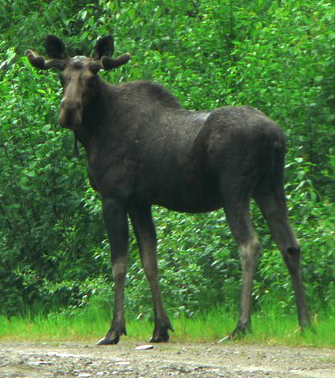
Now come warnings that moose on the move, extending their territory well into Connecticut and southeastern New York. And the difference between a moose and a deer is like the difference between a Doberman and a Chihuahua.
In September, a car struck and killed a 700-pound bull moose at Barkhamstead in upstate Connecticut. A month early, a crash killed a 500-pound moose in Goshen. These weren’t even “big” ones – moose can reach 1,100 pounds.
Connecticut wildlife experts estimate more than 100 moose are now in the state and their numbers are growing as their range extends southward toward metropolitan New York City.
What’s a motorist to do? The best advice is: Slow down! Be it deer or moose, or maybe even a 400-pound bear, the slower you’re going, the less the impact. You may even be able to avoid an impact altogether.
Tuesday, November 21, 2006
Beauty in the beast
Some also get a seasonal treat. At least one family places the family turkey, picked clean after Thanksgiving dinner, in the back yard each year. Like clockwork, the vultures appear to pick it even cleaner.
In the air, few birds can match the vulture’s beauty. They glide for miles on outstretched, six-foot wings that rarely flap – soaring, angling, dipping, and rocking, all as effortlessly as a goldfish in a pool. Sliding over the treetops as they approach their roost, they are like so many 747s arriving at an airport.
Close-up and on the ground, however, the vulture looks like a character from a horror movie. With the black body of a fat undertaker, the huge bird bears a featherless, big-beaked, red-fleshed head – all the better to dip into the corpses with.
Sometimes beauty is not only in the eye, but in the distance of the beholder.
Tuesday, November 14, 2006
Whoooo is there?
Concerned about the future of owls in the state, the Department of Environmental Protection has begun surveys to get a sense of their numbers, distribution, habitat, and habits in general. The problem with owls, of course, is that they are mostly nocturnal and are hard to see, so relatively little is known about them.Volunteer surveyors hit the road at midnight with special sound equipment that broadcasts the calls of Barred, Northern Saw-Whet, Great Horned, Eastern Screech, and Barn Owls. They play the calls and hope for responses. This year, teams traversed 13 routes with 130 survey points, and got responses at 30 locations.
They found more than 30 birds – but no Barn Owls like the one above. Perhaps like the buildings they are named for, Barn Owls are disappearing, too.
If you don’t mind night work and would like to help find whooooo’s around Connecticut, call Shannon Kearney-McGee, 860-675-8130, to volunteer for the 2007 owl survey.
Monday, October 30, 2006
Birds at night
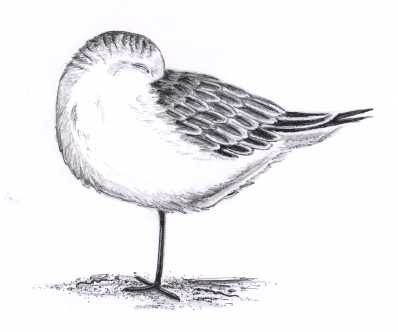
When heading off to sleep, birds are looking for protection from two things: enemies and the elements. Because of this – and, of course, the fact that it’s dark out – people rarely see sleeping birds.
Diurnal birds – those active in the daytime – have various ways of spending the night. Many small songbirds simply find a branch in a convenient tree to protect themselves from wind, rain and snow. Some favor thick bushes and shrubs. Many like spruces, hemlocks and other evergreens whose needles provide a degree of year-round protection. Cavity dwellers, such as woodpeckers and wrens, may make use of holes in trees or among rocks or fallen trees.
Outside breeding season, many songbirds such as robins, bluebirds and even cardinals will gather in flocks and sleep together. Some birds, such as crows, vultures, and starlings, will roost in great numbers. Roosts provide protection in numbers as well as a modicum of heat generated by all the bodies being fairly close together.
Gull, ducks and geese will float on water at night, usually in groups, while some shorebirds will settle down for the night on a relatively remote beach or in grass at the edge of the shore.
Some birds, such as Common Redpolls, ptarmigans and Ruffed Grouse, will bury themselves in snow at night, taking advantage of its insulating quality. It was a technique emulated by North American Indians as they journeyed away from camp in winter.
Tuesday, October 17, 2006
Fishing for cats
A case in point is the fisher. This 10- to 15-pound marten has long been found in northern New England and forested regions across North America. But until a few years ago, these weasel-like mammals were unknown here. Now that the trees are back, so are the fishers.
Sometimes called fisher cats, fishers neither fish nor are they even closely related to cats. In fact, they may be a cat’s worst enemy. Fishers usually feed on wild mammals ranging from mice and voles to porcupines and young deer. In suburbia, however, domestic cats are becoming a fisher delicacy. And there’s little a hapless cat can do – run up a tree and the arboreal fisher will follow right behind.
It’s another good reason why all pet cats should be house cats.
Tuesday, August 29, 2006
The embattled beaver
Pity the poor beaver. Although touted in countless film documentaries, the beaver’s industriousness is always getting the rodent into trouble.To establish ponded homesteads, beavers kill trees to build dams. The dams often flood roads, lawns, septic systems, parking lots, basements, and other trappings of suburbia, angering the human neighbors.
It wasn’t always so. Driven from much of the East Coast by farmers who chopped down most of the trees, beavers had vanished in many areas by the 19th Century. With the return of woodlands in the 20th Century, various reintroduction efforts were successful – so successful in Connecticut that some 8,000 beaver live in that small state today.
Adult beavers have no natural enemies – except man. They are among the few creatures legally hunted with what are called “kill traps.” Amazingly, kill traps are the only legal way to catch them in Connecticut; it is illegal to live trap a beaver to relocate it. The official state explanation: There are so many beavers in Connecticut that moving them would only exacerbate problems elsewhere.
Being industrious and a movie star doesn’t always pay.
Wednesday, August 23, 2006
Hitchhiking hummers
But a magazine, not children or backwoods naturalists, dreamed up a tale about hummingbirds, those hovering micro-birds that just now getting ready to return to Central America. In the 1880s, a writer proposed that Ruby-throated Hummingbirds, which weigh only an eighth of an ounce, couldn't possibly fly non-stop across the
Today, we know this is not true, yet the speculation has been told and retold till many consider it fact. But as is often the case in nature, fact is more amazing than fiction. Rather than hitchhike, this miniature creature, wings whizzing at 80 beats per second, zips non-stop across 1,000 miles of open sea at up to 40 miles per hour, twice a year.
Even more amazing is its metabolism. If you weighed 170 pounds and lived like a hummingbird, you'd burn 150,000 calories a day and produce 100 pounds of sweat. And if you ran out of water, your skin temperature would surpass the melting point of lead and you'd probably catch fire.
Wednesday, June 14, 2006
Two twitchers
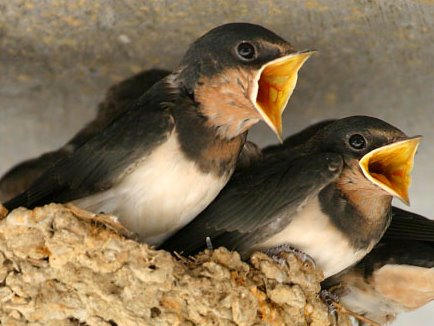
Most of our songbirds are altricial – like humans, they are born helpless and need to be waited on, break and foot, by their parents. To be fed, the youngest simply hold open mouths so wide, they seem to dwarf their bodies. As they grow older, they add voices to their food demands. And by the time they leave the nest, they twitch for attention – standing on a branch, wildly wiggling their bodies and their slightly open wings as a parent approaches with dinner.
This behavior may have inspired the British word, twitcher, which means a fanatic bird-watcher: It is said that true twitchers go into uncontrollable spasms of excitement at the sighting of a new species. So the next time you see a young sparrow or robin twitching for its lunch, think of an otherwise staid Englishman in his tweeds, binoculars raised, posterior all a-wiggle at the joy of spotting a Long-tailed Tit.
The Jeremiah Bennett Clan: T he Days of the Desperados One morning in 1876, a Ridgefield man was sitting in a dining room of a Philadelphi...
-
Dr. John G. Perry: Letter-Writing Civil War Surgeon A young Harvard-educated surgeon from a well-to-do Boston family experienced the ...
-
T he Bradford pear is a “street tree” that’s blessed with benefits and cursed with shortcomings. A cultivar of an Asian tree, the Bradford...
-
Charles Bluhdorn: The 'Mad Austrian' His death seemed like his life: face-paced and high-powered. Charles G. Bluhdorn, who b...