Showing posts with label history. Show all posts

Monday, October 10, 2016

John Hyde Preston: 
Debunking Liberal
John Hyde Preston made himself a bit unpopular with some of the populace back in 1933 when his book, “Revolution, 1776,” attempted to debunk many popularly held beliefs about the American Revolution.
The book declared among other things that the Declaration of Independence was made on July 2, not July 4, that John Hancock did not sign it until 47 days later, that the Liberty Bell never pealed the glad tidings, and that Betsy Ross did not sew the country’s first flag (Frances Hopkinson did, the author said.)
Preston also maintained that more Americans probably served with the British than with the Continental Army.
John Hyde Preston was born in 1906 in New York City. He wrote articles for Harper’s, The Atlantic Monthly, McCalls, Holiday, and other magazines and lived in many places both hereabouts (Ridgefield, Wilton and New Canaan) and in the world (Italy, Denmark, and Iceland). He spent his last 10 years in Canada where he died in 1980 at the age of 74.
Preston wrote both novels, such as “Portrait of A Woman” and “The Liberals,” and non-fiction, such as “Mad Anthony Wayne, Gentleman Rebel” and “Revolution, 1776.”
Herschel Brickell, the editor and critic who lived and died in Ridgefield, wrote of “Revolution 1776,” “Mr. Preston is no conventional historian. He knows his subject as well as anyone, but he breaks with tradition in writing entertainingly. This is a fine book. “
However, Howard Fast, the historical novelist who lived in Ridgefield years later, decried Preston’s work in a long essay, published in 1950 in a scholarly journal.  For instance, citing Preston’s questionable description of a revolt of troops corralled by Mad Anthony Wayne, Fast asks, “Where did Mr. Preston get his information and what prompted this gratuitous slander of brave men – so much in the style of today – who had fought tirelessly and well for five years?”  
Preston  lived in Ridgefield in the 1930s and was better known locally for “The Liberals,” his first novel, in which the Gilbert and Bennett wire manufacturing company in Georgetown was cast in an unfavorable light. The “left-wing novel”  (written in 1938 on yellow paper that  Preston bought at the Ridgefield Press office) features the head of the wire mill who is good to his employees but who hates
unions, and a young playwright who is love with the daughter of one of the mill workers battling the boss. A New York Times critic said the book “digs into the foundations of the modern economic structure and exposes much of the rot which undermines it.”
While it has a liberal slant, the novel also points out problems of liberals and their intellectual floundering. “We weigh everything until it evaporates,” says the playwright’s girlfriend. “We’re like John Dewey, taking the 10-year-old intelligence tests and failing them. Dewey knew so many answers to every question that he tried to give them all and when he was through, he flunked a test that any normal 10-year-old could pass. And that’s what we do. We doubt and juggle and re-examine until we can no longer give the simple answers.”
Preston, incidentally, described the mill as being in a small village near the town of Hatbury, Conn. The Times reviewer said he should have said Danbury (once the hat-making capital of the U.S.).  “The fictitious substitute seems needless and often is unreasonably irritating.”


Monday, April 21, 2014

April’s origin

April has had a bad time of it. Songs bemoan its showers, a poet calls it the “cruelest month,” its length has been cut, and its first day is for fools. Even the origin of its name is uncertain.

In the early Alban calendar, April was the longest month, with 36 days. Various Roman emperors fiddled with its size until Julius Caesar chose the 30 days that stuck. Because April is the time when trees and flowers come to life, many scholars believe its name came from the Latin, aperire, which means “to open.”

Others have pooh-poohed this idea, pointing out that no other month has been named for a condition of nature. Instead, they say, the likely source is a goddess.

These scholars, steeped in dusty mythology of ancient Greece and Rome, maintain that the Romans dedicated this month to Venus, the goddess of love, because April is the month when nature begins its myriad methods of reproduction. The Greek for Venus was Aphrodite, and, the scholars say, that is the root of the name – from Aphrodite to Aphrilis to Aprilis to our April.

Aperire seems so much simpler and more reasonable.

Saturday, February 16, 2008

The humble Valentine

While many of us may suspect that St. Valentine’s Day was invented by the modern greeting card, flower and candy industries, the holiday is ancient – and unsaintly.

More than 2,000 years ago, Romans celebrated Lupercalia, a fertility feast that included ceremonies in which men drew women by lots. When the early Christian church tried to “depaganize” Roman feasts, it turned this one into a festival of love in which people drew the names of saints instead of women. It was named for St. Valentine, probably because his feast day roughly coincided with the mid-February celebration of Lupercalia. The priest had been beaten and beheaded around Feb. 14, 270, for practicing Christianity.

By the 19th Century the celebration of St. Valentine’s Day in England, at least, was not unlike today’s. One British author wrote in 1873: “The approach of the day is now heralded by the appearance in the printsellers’ shop windows of vast numbers of missives calculated for use on this occasion, each generally consisting of a single sheet of post paper, on the first page of which is seen some ridiculous coloured caricature of the male or female figure, with a few burlesque verses below.” These, the writer adds, are employed chiefly by “the humbler classes.”

So have a humble – but happy – Valentine’s Day!

Wednesday, December 19, 2007

Going a gooding

Dec. 21 is the feast of St. Thomas, the apostle and patron saint of builders and architects. In many parts of Old England, however, it was also the day of St. Thomas’s Dole.

Doleing Day or Mumping Day was when the poor of a community – particularly the old women – would visit the well-to-do in search of handouts. This form of pre-Christmas begging or “mumping” was called “going a gooding.”

Doleing Day was a time of good cheer, and many of the poor were invited into homes for not only gifts of money or grain, but also a sip or two of John Barleycorn. In return, they gave their hosts sprigs of evergreens to use as seasonal decorations.

In the spirit of gooding and giving, perhaps Doleing Day would be a good time for us to sit down with our checkbook and pen a few gifts to agencies near and far that could use our help. So many of our thoughts are with family and friends that we may overlook the needy in our midst and in the world.

This Friday, Dec. 21, do good and dole.

Tuesday, July 31, 2007

Dog Day Update

The Dog Days are well underway and the news so far is pretty good.

A hand-me-down from ancient times, the Dog Days extend from July 3 through Aug. 11. The Greeks and Romans knew that Sirius, the Dog Star, rose simultaneously with the sun during this period. They believed that since it was such a strong star, Sirius added to the sun’s heat, making the Dog Days the hottest time of the year.

English countrymen said that if it rained on the first Dog Day, the rain would continue for 40 days. Those who’ve inspected their lawns lately know well that, after a wet spring, the sun has been doing a lot of shining these dog days – except maybe for last Monday.

But that’s good, say the English, who also believed:

Dog days bright and clear

indicate a happy year.

But when accompanied by rain,

for better times our hope’s in vain.

Sunday, July 08, 2007

July’s power

July is the month when the sun is strongest. In our neighborhood, high temperatures average 84, five degrees warmer than in June and three higher than in August.

Because the sun shows so much power in July, Mark Anthony had the month Quintilis changed to honor his late friend, Julius Caesar, a man of great power. The change also eliminated the nasty problem of the seventh month being named five, its old position in the Roman year.

The ancient Saxons were more down to earth about naming their months. July was Hay Monath, when they mowed and harvested hay, or sometimes Maed Monath, supposedly because the meads – the meadows – were in bloom then. However, mead is also an ancient alcoholic beverage made from fermented honey.

And since it’s said that mead imbues the drinker with wisdom, courage and strength, perhaps Maed Monath is the time to sit back, sip some mead, and quietly seek these admirable qualities.

Friday, March 16, 2007

Pain relief

An amazing thing about the Pussy Willow is its color – or more specifically, the lack of it. Few shades are duller than gray, yet the flowers of the Pussy Willow are among the most beloved of any spring bloom.

Therein lies its charm. This bush wins us with form, not flash. Its catkins are catlike, all cute and furry like the tail of a kitten, and they wrap themselves along the branches like so many fuzzy caterpillars marching to the sky.

It also wins us with timing, blooming with the first thaws of March. But for those in a hurry for signs of spring, snipping off a few bloomless branches and sticking them in water will net wands of premature catkins.

The wonders of the willow were known to Hippocrates in ancient Greece and to North American Indians. However, both were interested not in the flowers, but the bark, which produced a painkiller called salicin. This, in turn, led to the discovery of salicylic acid, and to synthesizing acetylsalicylic acid – what we call aspirin.

So, it seems that Pussy Willows can relieve a lot more than just the bleakness of winter.

Tuesday, January 30, 2007

Hoop poles

Mention a “hoop pole” today and you might inspire images of basketball or tent supports. A century or two ago, however, hoop poles were a well-known and valuable commodity that many local farmers harvested from the wild to earn extra cash.

Hoop poles were long, straight rods, cut in the woods from ash, hickory, hazel, and white oak saplings or from bushes that had been specially pruned for the purpose. While they might be cut in spring or fall, farmers often processed them in midwinter, when they were less busy. Bark and shoots, for instance, had to be removed.

The poles were used around the farm for many tasks such as rollers for moving heavy loads and for temporary floors under haystacks. They were also split to make barrel hoops and basket-weaving material; the poles were hammered to flatten them, soaked in water, and then split into the hoops that held the barrel staves together.

Perhaps the oddest use for hoop poles, however, was as stiffeners in the colossal, but fashionable skirts women sometimes wore in the 19th Century.

Tuesday, January 23, 2007

Role of roads

From the earliest days of our communities, highways were of great importance, but for much different reasons than they are today. The role of roads has changed significantly in the past century or so.

Two hundred ago, roads were chiefly lines of communication. They connected homestead with homestead, families with town and church, and towns with towns. There were no telephones, no radio, no television, no Internet, and no local newspapers. News traveled mostly by word of mouth, and mouths traveled over roads.

In those days work kept most people at home, not away from it. The farm was their occupation and their chief source of food and clothing. Today, work is often far from home and supplies are in town or the nearby city, all reachable by highways. News, on the other hand, arrives with the flick of a switch, the opening of a mailbox, the toss of a paper carrier, or the ring of a telephone.

In many ways, a road of old was like a wire of today.

Wednesday, January 17, 2007

Uncomfortable cold

Temperatures have dipped into the teens, and ice is forming on ponds. Yes, we’re finally feeling cold.

What we’re feeling, though, is nothing like what folks used to feel.

The people who settled New England experienced cold as you would never want to. In January and February, frigid air was a 24/7 phenomenon inside most houses, which were inefficiently heated and poorly insulated.

Until the arrival of central heating in the late 19th Century, houses were often iceboxes in winter. It was not unusual to have the water in the house turn to ice overnight and to have snow leak through windows and stay frozen on the floor. Frostbite was a problem not only outside, but indoors, where bedroom temperatures could approach zero. And let’s not even think of what outhouses were like.

So as your nose and fingers tingle and your breath freezes in front of you when you leave your well-heated home, take a moment to remember those hardy people who came before us and who knew few comforts at this time of year.

Monday, January 01, 2007

Tie Hacking

New England farmers were famous for not wasting time, energy or resources. Even in January and February, when the ground was frozen and snow covered, they were hard at work outdoors.

Mid-winter was the time for cutting down and chopping up trees. Most wood was bound for the fireplace or the stove, but not all.

In the 19th Century many local farmers made railroad ties. Tens of millions of these eight-foot, six-inch logs were needed yearly, not only to support new tracks being laid across America but also to replace existing sleepers, whose life expectancy was only about five years. The ties were cut and sledded back to the farm where were they were hand-hewn into shape. In the spring or summer, they were carted to the depot and sold to the railroad.

Even the bark shaved off the logs was saved and sold to local tanneries, which used bark extract in processing leather.

“Tie hacking,” as it was called, provided useful income to many people, most of whom were subsistence farmers growing little more than was needed for the family. In fact, many farmers earned more from winter work than summer crops.

Tuesday, December 19, 2006

The Lord of Misrule

Christmas celebrations are not always sacred and solemn, as we well know, but one of the oddest practices was once commonplace in old England where the Lord of Misrule reigned at this time of year.

Cities, towns, and universities across the country appointed these public officials for the 12 days of Christmas. “His duties,” said a 19th Century historian, “were to lead and direct the multifarious revels of the season.” It was no trifling job, either; the Lord of Misrule of London in 1635 spent 2,000 pounds – nearly $500,000 today – on public merriment.

One of the lord’s first official acts each year was to absolve all people of their wisdom, but to demand that they be just wise enough to make fools of themselves. He then set about encouraging “reveling, epicurisme, wantonesse, idlenesse, dancing, drinking, stage-plaies, masques, and carnall pompe and jollity,” according to one contemporary critic.

In an era with no shortage of misrulers in the world, it’s a wonder the ancient office hasn’t been resurrected.

Tuesday, December 05, 2006

Firewood words

“Don’t let it lie in great sticks,” the Old Farmer’s Almanac urged its readers for December 1864. The season of sawing and splitting was here.

For the local farmers, early December was the time to work on wood, not for the winter ahead, but for the next summer and beyond. Wood for stoves and fireplaces needed drying, for sap-filled “green” wood cuts heat output by a third. Split up, firewood dries quickly and, as the almanac exhorted, it was best left outside a while in the late-fall weather. “Give it the wind a few weeks before housing, and it will dry all right,” the “old farmer” wrote.

Today, many people still heat with wood, using sophisticated stoves that burn logs and even conveyor-fed wood pellets, or employing high-tech furnaces that can burn both wood and propane or fuel oil.

But the old farmer’s old advice on firewood still holds true: Dry it right to burn it well.

Tuesday, February 07, 2006

The miry mess

Most folks in town a century or two ago would have not been pleased with the warmer than usual winter of 2005-06. It’s not that they loved cold; it’s just that they liked to get their work done.

Warm winters were a muddy mess, and mud was the enemy of the farmer. When the ground was frozen, the narrow wheels of wagons could handle the dirt roads and farm paths with ease. Thawed, roads and paths were one miry mess after another.

When the ground was snow-covered, life was even better for the farmer, whose slays, sleds and sledges could get much more work done than could wheeled vehicles. A horse could drag four times more weight on a sled across snow than could a wheeled cart across dirt.

That meant that farmers could easily haul timber home from the woods to cut for firewood, to saw into lumber, or even to hew into railroad ties. It meant that stoneboats could remove large boulders from fields, and that other heavy-duty tasks could be accomplished.

Winters may have been colder back then, but the work was harder and kept people warmer.

Tuesday, January 24, 2006

The Hessian fly

In the 19th Century, farmers here grew many crops, but the most common grain – wheat – was generally not among them. This was probably because of the Hessian fly.

Hessian fly? Not your everyday bug of 21st Century suburbia, yet this mosquito-like insect had a major impact two centuries ago because its larvae sucked the life juices from wheat.

The insect, which first appeared on Long Island around 1779, is believed to have arrived with Hessian soldiers fighting in the Revolution – hence, the name.

Many farmers in the Northeast gave up the crop – despite the fact that no less a personage than George Washington urged them not to do so. Washington recommended growing yellow-bearded wheat, which was more resistant to the larvae.

Hessian fly is still around and now attacks wheat coast to coast. But fly-resistant wheat varieties have been developed and are so successful that insecticides are often not needed to combat this strange, living remnant of a war fought 225 years ago.

Tuesday, January 10, 2006

The door

Most months have dumb names, honoring egotistical emperors and long-dead gods, or saying they are the 10th when they are the 12th. But at least January makes a statement.

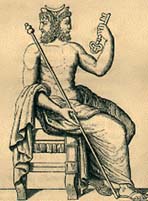
Centuries before the Christian era, a king named Numa Pompilius decided the Roman world needed more months than the 10 it had. So he added two and, unlike Julius Caesar and Augustus, was modest enough to keep his name off both. The first, placed at the beginning of the year, was named for Janus, the god of doors. Yes, back then, even doors had a god.

But to old Numa, this was appropriate. January opened the door to the new year, so why not have Janus there to make sure we didn’t trip over the threshold.

And it sure beats the old Saxon name for the month. They called it Wolf-monat because that’s when wolves were the hungriest and most apt to gobble up a Saxon foolish enough to be wandering out of doors in January.

Tuesday, January 03, 2006

Codswallop!

In the vast vocabulary of the English language, some words seem more fun than practical. Such is codswallop.

Dictionaries say it means “nonsense,” but most are uncertain of its origin. Some etymologists tell of a 19th Century British inventor named Hiram Codd, who created a soda bottle with a glass ball in its neck. The pressure of the bubbly contents forced the ball against the neck, providing a built-in stopper that you pushed in to pour. It was a successful invention (though kids kept stealing and breaking open bottles to get the “marbles” inside).

Nineteenth Century denizens of the pubs, who used “wallop” as slang for beer, sneered at these fizzy, sweet drinks, calling them “Codd’s wallop.” The derogatory term grew to become an expletive for something silly and useless – nonsense.

Some etymologists dispute this derivation, claiming the story itself is codswallop, but they can offer little better.

Readers of this essay may consider it, too, to be codswallop. However, we live in a world full of codswallop, so why not just a little bit more?

Tuesday, December 20, 2005

Merry Xmas

At this time of year a century ago, newspapers were full of references to Xmas. Editors were not being disrespectful of the holiday or its origins, however. Xmas is, in fact, a word more than 500 years old, invented and widely used by Christians, including parish priests and monastery monks.

For many centuries, X has been an abbreviation for Christ. X is the English representation of the Greek letter, x, the first letter in the Greek word for Christ. While the letter is pronounced “chi,” it is used for the sound, “ch,” as in “Bach.” (Thus, technically speaking, Xmas could be pronounced “kmas.”)

But in the 1950s, someone decided that Xmas was just some Macy or Gimbel effort to take Christ out of Christmas. Despite centuries of its use by devout clerics, a movement developed that declared Xmas a secular plot, promoted by greedy stores and lazy – or worse, atheistic – newspaper writers.

Abbreviations are symbols for written words, just as written words are symbols for sounds. Xmas is just another way of respectfully writing Christmas, a little more quickly in a little less space.

Sunday, September 04, 2005

Caesars and Saxons

September, the ninth month, is named the seventh. But it might have been called August, were it not for July.

In ancient Rome, when the year began in March, September was the seventh month and had 31 days. The emperor Augustus decided he was important enough to warrant a month to honor him, just as Julius Caesar had July named for him. Julius’s honor came posthumously, but Augustus was not about to let death rob him of enjoying his tribute.

Augustus should have picked September, his birth month, just as July was Julius’s. But Sextilis, the sixth month, was next to the month of his famous predecessor. Besides, Sextilis had been a lucky month for him, so he renamed it instead. But Augustus didn’t want only 30 days when Julius had 31, so he added a day to August – and took one from September.

In naming their months, the practical and thirsty Saxons were not interested in self-aggrandizement. September was Gerst monat, the barley month, named for the crop harvested then and the chief ingredient in their favorite beverage: Beer.

Monday, August 08, 2005

August, the Eighth

Some people go out of their way to be remembered after they’ve gone. For instance, when he gave the beach to the town of Ridgefield, Conn., the late Francis D. Martin required it be named Martin Park.

But few people have succeeded at being memorialized better than Caesar Augustus, the Roman emperor. He took a month long known as Sextilis, and changed it to Augustus in his own honor. He probably did us a favor, however, since Sextilis means sixth. Augustus’s predecessor, Julius, had reformed the calendar into a 12-month affair in which Sextilis became the eighth month, and which he should have renamed October, which means eighth. But Julius had made the eighth month the 10th month, and had left its name October. Thus, we would have had two months that were eighth, even though one of them was 10th.

Caesar Augustus did something else useful. Julius had made the month 30 days instead of 29. Augustus decided that he should be the equal of Julius, honored in the previous month’s name, and he swiped a day from February to add to August.

Good move! Who wouldn’t want more August and less February?

  The Jeremiah Bennett Clan: T he Days of the Desperados One morning in 1876, a Ridgefield man was sitting in a dining room of a Philadelphi...