Showing posts with label insects. Show all posts

Wednesday, May 07, 2014

The stinky tree

The Bradford pear is a “street tree” that’s blessed with benefits and cursed with shortcomings.

A cultivar of an Asian tree, the Bradford is actually a Callery Pear (Pyrus calleryana). Joseph Callery, a French missionary, “discovered” the species in China and sent it to Europe to be classified – and enjoyed. Today, it’s found along countless miles of American town and city streets. It laughs at pollutants like auto exhaust or road salt and needs barely a square foot or two of exposed earth as it rises from a cement sidewalk next to an asphalt highway.

In early spring, the Bradford produces thousands of showy, white flowers. Unfortunately, the blossoms reek – the smell has been likened to long-unwashed sweat socks. It’s a scent, nonetheless, that attracts scores of pollinating insects.

The tree has another disadvantage: It’s weak and it breaks. Sometimes, Bradfords split down the middle.

However, a rarely mentioned benefit of the Bradford pear is its tiny, marble-sized fruits. Birds love them, especially in the middle of winter when food is sparse. Even in January, it’s not unusual to see robins, cardinals, Blue Jays, even flocks of Cedar Waxwings, wandering its branches, snacking on the fruit, right in the middle of a town or city.

For that alone, we’ll deal with the spring stench and the risk of being beaned by a branch.

Friday, April 11, 2014

Scilla season

Late March and early April is the season for scilla, a pretty wildflower import that is hardy enough to survive freezing nights and conservative enough not to make a weed of itself.

Scilla siberica is a native of the woodlands of Eurasia. A century or so ago, planting its tiny bulbs was all the rage and today, many old homesteads have sections of lawn that, in early April, turn blue with thousands of small flowers that have spread from those old plantings. If the weather remains cool, the blossoms can last for weeks, providing not only beauty for the eye but nourishment for bees.

Scilla, also known by the rather unattractive name of squill, used to be more common, but some modern owners of antique houses spread weed killers on their lawns, wiping out the old colonies.

They did to scilla what scilla might do to them if they ate it. The word is from the Latin, “to harm,” reflecting the fact that most species are somewhat poisonous – which is actually a boon to gardeners.

It explains why, when so many other flowers are gobbled by the hungry deer, scilla blooms brightly and plentifully – as long as lawns remain poison-free.

Wednesday, March 26, 2008

Treetop visitors

Spring’s leafless trees are a far cry from Shakespeare's bare ruined choirs of winter. Where late the sweet birds sang is springing to life with song. Those branches are the hotels and summer homes of countless migrants.

The earliest of the tree flowers are blooming. Where there are flowers, there are usually insects. And where “bugs” are, birds are sure to follow. In fact, insects drawn to the early-flowering trees are important food for warblers, tanagers and other small migrants heading north in the weeks to come. Some will stop here to nest for the summer while many others eat and run, heading farther north.

For bird watchers the leafless limbs of early spring are a blessing. The scores of colorful arrivals are much easier to spot without lots of green blocking the view.

So instead of watching spring arrive on the thermometer, dust off the binoculars and point them to the passing parade of treetop visitors.

Tuesday, November 06, 2007

Troubled waters

Not all invasive plants are found in woods and wetlands. Aliens also harm lakes, ponds and streams. Witness water thyme, which a UConn professor called “one of the world's worst weeds” and the director of the Invasive Plant Atlas of New England described as “a thug.”

Imported from Africa as an aquarium plant, Hydrilla verticillata clogs lakes and streams, pushes out native species of plants, fish and birds, and can even halt boat traffic. Across the nation hundreds of millions of dollars have been spent battling water thyme, using everything from herbicides to a Hydrilla leaf-mining fly from Pakistan.

While one group of scientists looks at how to kill Hydrilla, another eyes it from a different angle. Researchers have found water thyme is rich source of proteins, calcium, potassium, lipids, carotenoids, RNA, DNA, magnesium, iron, vitamins B1, B2, B3, B5, B12, phosphorus, manganese, zinc, copper, cobalt, 17 amino acids, and essential enzymes. Some claim it's an effective muscle builder and energy enhancer. University studies indicate it may be an appetite suppressant.

And that's just for humans. The University of Florida has found that water thyme increases the yield of milk in dairy cattle and the egg-laying capacity of hens.

So maybe there's another answer to controlling this latest invasive thug: Let’s all eat it.

Tuesday, October 23, 2007

Don't be sweet

The bees are really bad this year,” someone said the other day.

He was wrong on two counts. Bees are rarely bad. Nearly all of the 3,300 species of bees in North America provide a service without which we would be very uncomfortable. They pollinate flowers, which produce most of the fruits and many of the vegetables we eat.

Of course, he was not speaking of bees, but of wasps, the yellowjackets, which are so common at this time of year. Because it's yellow and looks something like a bee, it is a “bee” to many people. It's a bad rap for the bees.

Yellowjackets become so pesky in late summer and autumn because workers are seeking sweets for the new crop of queens, the only ones who will overwinter. Unlike most bees that limit their foraging to flowers, yellowjackets are drawn to anything sweet: the perfume you're wearing, the soap you used, the food you're eating.

If you are annoyed by yellowjackets and especially if you're sensitive to their sting, shun perfumes, hairsprays or scented laundry products; use unscented soaps; don't drink sodas or eat fruit outdoors; and stay away from fallen apples and other sugary fruits. In other words, don't be sweet.

Friday, October 19, 2007

The oothecas of autumn

In the autumn, if you snoop around a goldenrod grove, you’re apt to come across the ootheca of the Praying Mantis. You might want to bring it home and put it in the freezer.

Mantises love goldenrod. When it’s blooming, they perch near the flowers and prey upon the wealth of visiting insects, enjoying their last meals before the cold kills them. “Mantis” means “prophet,” and as they sit motionless with forelegs folded, they seem to be in a religious trance.

Before departing this world, the female will often use the goldenrod’s stiff stalks to attach one or more oothecas, the cases that hold the eggs until they hatch the next spring and provide a new season of mantises.

Why bring egg cases home? Praying Mantises are among our most beneficial insects, consuming many pest species. Serious gardeners buy egg cases, containing up to 300 eggs each, to hatch in their gardens and greenhouses. The mantis is so much admired that Connecticut has declared it the “state insect.”

So for some natural pest control next season as well as some insectival entertainment, put some oothecas in the freezer. Take them out next spring, put them in the garden to hatch, and watch the prophets pray for prey.

Wednesday, September 05, 2007

The season for sneezin'

As millions of tons of sneeze-provoking pollen is spewed the air this season, innocent bystanders invariably get the blame.

Goldenrod is often cited as the cause of hay fever simply because it's so brilliant at a time when its humble but potent cousin, ragweed, is also blooming. As a result, misguided allergy sufferers destroy countless goldenrods, one of the great seasonal sources of color and scent as well as nectar for bees.

Airborne pollen causes hay fever. Most flowers with airborne pollen – ragweed, plantain, grasses, many trees – are green and unnoticed, hidden among their own leaves. They're green because they don't need to be “different” to catch the eye of passing bees and other flying pollinators – they use air, not insects, to effect pollination. Goldenrod has bee-borne pollen, too heavy to float in the air and up the nose. Its yellow helps attract bees to haul its pollen around.

Thus, despite all the colorful TV and magazine ads for allergy medications, few if any brightly colored flowers will ever tickle your nose or tighten your chest. Wheezers and sneezers should join everyone else and enjoy Mother Nature's late summer explosion of yellow.

Tuesday, July 17, 2007

Alien threats

Illegal immigrants are much in the news lately, but immigrants of a different sort are sneaking across our borders and causing havoc.

The Emerald Ash Borer, a beetle from Asia discovered here in 2002, has killed countless ash trees – more than 20 million in Michigan, Ohio and Indiana alone. It has cost towns, property owners, nurseries, and forest products industries – even baseball bat makers – tens of millions of dollars. It’s just one of a passel of insect and plant pests that have entered our country hidden in packaging or produce. Some problem plants, such as Purple Loosestrife, Japanese Knotweed and Yellow Flag Iris, were imported deliberately because of their beauty, only to become bulls in an environmental china shop.

Without natural controls, some alien plants spread wildly, pushing out native plants and in the process destroying ecologies that support many native birds, fishes, reptiles, amphibians, and insects.

What can we do? Know and destroy invasive plants. And insist that legislators support not only better surveillance of our ports of entry, but also research into combating imported pests that have already arrived.

Our leaders must understand that not all alien threats to our nation come from terrorists.

Tuesday, July 10, 2007

Does your furniture click?

Behold the beetle, perhaps the most successful of all life forms. One in every five species on Earth – including plants – is a kind of beetle. More than 24,000 different beetles live in North America alone.

Many are well-known. In July, for instance, we find lady bugs, fireflies, and – despite their name – June bugs. Most share a common trait: Their first pair of wings has hardened into plates that provide protection. When the beetle needs to fly, these plates, called elytra, are raised to unveil the flight wings.

Most beetles are harmless. Some are pests, however, and a few annoy in odd ways.

Take the Death-watch Beetle, which bores its way into wood, including furniture. To communicate, males and females rap their heads against the tunnel walls, producing a clicking sound. To folks generations ago, clicking furniture meant a death in the family was imminent.

Then there is the Drugstore Beetle. “Virtually nothing organic is off-limits to this insect, including leather, flour, dried beans, and cayenne pepper,” write Eric Eaton and Kenn Kaufman in the Kaufman Field Guild to Insects of North America. “It will even bore through plastic vials to get to a meal.”

Or how about the Cigarette Beetle, which loves dried vegetable matter, but is especially fond of tobacco. It favors chewing, though. “So far, it has not been observed smoking,” report Eaton and Kaufman.

Tuesday, April 10, 2007

Swamp carcasses

The spring air is full of rich earthy scents, especially over our swamps. Often leading the wetland aromas is the skunk cabbage.

Many know but few admire this big, fetid fellow. Yet, it is one of our most fascinating wildflowers, finely tuned by evolution to deal with a harsh time of year. As it rises in late winter and early spring, the plant burns carbs – just like exercising humans – heating up and melting the frozen earth around it. Once up and blooming, the flower head – protected by a reddish-brown hood – can be as warm as 70 degrees when the air outside is 30.

The hood’s hue serves a second purpose: It’s the color of carrion. Flies are the first insects of the new season. Searching for the thawing carcasses of winter-killed creatures, they are drawn to the color and the smell, thinking the cabbage is a corpse. The plant’s warmth is a plus, encouraging the flies to roam about the ball of flowers, unwittingly picking up pollen to carry to the next mouth-watering skunk cabbage down the line.

The tricks may stink, but they work.

Tuesday, June 27, 2006

Backyard gold

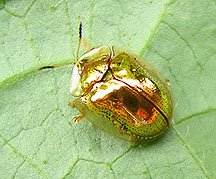
All that glitters may not be gold, but if you run across Metriona bicolor, you wouldn’t mind at all. At least, not if it’s an adult.

Like a drop of molten gold, the Golden Tortoise Beetle clings to and munches on the leaves of morning glories – or, on the wild side, the closely related bindweeds. The golden shell glows with iridescence. Put one in your hand, however, and watch the color change to mother of pearl, and then dull orange as the insect manipulates the moisture content in its shell.

Seen on a leaf, the lustrous beetle is hard to believe. Perhaps even more amazing is the fact that the beautiful adult sprang from a “filthy” kid. The black, fork-tailed larvae of the tortoise beetle camouflage themselves by collecting excrement, attaching it to their backs, and walking around under a load of, well, crap.

This tiny Jekyll and Hyde is yet another example of the wonders of nature right outside your back door.

Tuesday, May 02, 2006

Zap the cracklers

Snap. Crackle. Pop.

The sound is not cereal but the death knell of the 71 billion insects killed annually in ``bug zappers.''

“Great,” you say. “The only good bug is a dead bug.”

The fact is, however, that most insects killed in zappers are beneficial or, at the least, not harmful or even annoying. Many are food for wildlife such as birds and fish. Others, like ladybugs and tiny wasps, attack and control harmful insects. Still others, including moths, are flower pollinators.

The mosquitoes and biting flies that owners think they’re killing aren’t even attracted to the device’s ultraviolet light. One scientific study of the contents of bug zappers found that of 13,789 bodies, only 31 were biting insects. That’s less than one-quarter of one percent and an incredible waste of not only life, but electricity.

The irony, the researchers said, is that bug zappers destroy many of the insects that kill and control mosquitoes and flies.

Do the world a favor and zap your zapper.

Tuesday, January 31, 2006

The moths of winter

It’s a February night and you’ve got the porch light on. It’s 37 degrees out, but there, fluttering around the lamp, is a moth.

Moths in winter are not freaks of nature. In North America, at least 50 species may appear throughout the winter – as long as the temperature is above freezing.

Specially adapted to cold weather, they have furry bodies and circulation systems designed to retain heat while keeping flight muscles flexible and functioning. Many dine on tree sap, high in sugar and energy content, and they shiver to warm up. When the temperature dips too low, they can tuck themselves under some leaves and nod off till the next thaw.

Why should moths bother to adapt to an environment so hostile to a cold-blooded creature? In many ways, winter is less hostile than summer. There are no night-flying bats or birds to gobble them up; the bats are hibernating and birds are down south.

For some creatures, there’s safety in camouflage; for others, safety in numbers. But for wintertime moths, it’s safety in shivering.

Tuesday, January 24, 2006

The Hessian fly

In the 19th Century, farmers here grew many crops, but the most common grain – wheat – was generally not among them. This was probably because of the Hessian fly.

Hessian fly? Not your everyday bug of 21st Century suburbia, yet this mosquito-like insect had a major impact two centuries ago because its larvae sucked the life juices from wheat.

The insect, which first appeared on Long Island around 1779, is believed to have arrived with Hessian soldiers fighting in the Revolution – hence, the name.

Many farmers in the Northeast gave up the crop – despite the fact that no less a personage than George Washington urged them not to do so. Washington recommended growing yellow-bearded wheat, which was more resistant to the larvae.

Hessian fly is still around and now attacks wheat coast to coast. But fly-resistant wheat varieties have been developed and are so successful that insecticides are often not needed to combat this strange, living remnant of a war fought 225 years ago.

Tuesday, August 23, 2005

Butterflyways

Nature can be remarkably adaptable. Many examples have been documented of how wildlife has profitably used modern eyesores. Old cars dumped offshore create artificial reefs where fish, mollusks and crustaceans thrive. Once-rare peregrine falcons make their homes on microwave relay towers.

Now, one of the ugliest wounds man has cut into the landscape has been found to have its good side, too. Butterflies love interstates.

“Highways are of major importance for butterflies,” reports Jeff Boetner, a University of Massachusetts entomologist, who discovered that Silvery Blues (pictured), Common Ringlets and other species are extending their ranges, thanks to the interstate highway system. As one observer put it, “viewed from the perspective of a butterfly, an interstate highway is just an endless, sun-drenched field.”

This is especially true of roads that have been planted with wildflowers, a project many states have taken on more aggressively than our own. Be they herbs or shrubs, plantings help reduce the ugliness of expressways; if they provide food and shelter for wandering butterflies and birds, so much the better.

Now if our winged friends could only learn to fly above – not through – the traffic…

Monday, August 08, 2005

Arboreal love songs

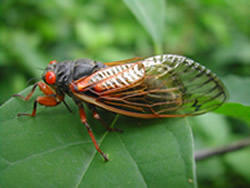
The trees are alive with the sounds of cicadas, summer songs that prove that sweet notes don't necessarily have to be pure notes.

These big-bodied bugs live high in the trees, seemingly celebrating the years -- from two to 20 of them -- they were burrowed underground. There, the nymphs had sucked root juices and hibernated until, one evening, they emerged as large brownish-black bugs and flew to the nearest treetop.

As the sun rises and the day warms, the male cicadas' odd songs grow stronger. No sound better symbolizes a hot summer day than the crescendos of their overhead buzzing. Each of some 75 species found in the East has its own time of day for singing and its own particular note -- in some well-cicadaed parts of the tropical world, people tell the time of day from the different species' songs.

Unlike crickets, which make their sounds by rubbing their legs against their bodies, the cicada sings with a membrane, vibrated by muscles, on its thorax. The arrangement is not unlike a drum without drumsticks. In fact, the cicada's sizable body is largely hollow, acting as a sounding box that helps throw the song hundreds of feet through the trees. The males join in a chorus to increase the volume.

The aim, of course, is to attract females. One might say the cicadas are drumming up a summer love. It is their last fling, for soon they'll die. But they'll leave behind eggs of cicadas that will sing to us again, two, five, 13, maybe even 17 or 20 years from now.

Monday, August 01, 2005

Beauty and the bugs

In fields and wetlands throughout the Northeast, Galerucella calmariensis and its cousin, Galerucella pusilla, are chowing down, guests of federal and state governments.

These two European beetles were invited over to do battle with a beauty that botanists believe is a beast. The Purple Loosestrife, whose tall wands of richly colored flowers are so plentiful at this time of year, was imported more than a century ago to grace our gardens. Like many another newcomer, the plant found North America much to its liking, so much so it is now choking out native species and altering vast wetland habitats.

In Europe, Purple Loosestrife is naturally controlled by leaf-eating insects like Galerucella and probably by other plants that aren’t as easily overcome by its dense colonies. Scientists spent years studying the beetles and believe importing them will not harm any other species. Let’s hope they’re right – not everyone is convinced that introducing alien insects is wise. What’s more, beekeepers love loosestrife because of the nectar it provides at a fairly dry time of the floral year.

Odd, that a plant causing such a commotion bears a name that recalls its old use as a peacemaker.

Saturday, June 25, 2005

Beauty and the beast

Nature is full of strange transformations. While the caterpillar to the butterfly is best known, another beauty and the beast scenario is perhaps more beneficial to humans.

Lurking in the bottom slime of ponds and slow brooks are creatures even Stephen King might find hard to imagine. These long, dark, six-legged creepers have huge retractable lower lips – sometimes a third the length of their bodies – designed to snare victims and feed them into their razor-sharp mandibles. Why, these monsters even breathe through gills protruding from their rectums.

Yet, they are just children. As adults, they are so elegant they’ve inspired the design of countless pieces of jewelry and even Tiffany lampshades.

Fortunately, perhaps, the nymph of the dragonfly stays out of sight in the muck while its handsome transfiguration flies about for us to enjoy. But in either form, dragonflies gobble up large numbers of mosquitoes, larval or winged, helping keep them under control.

Thus, beauty or beast, either is a friend.

Tuesday, June 21, 2005

Clever caterpillars

In the late spring and early summer, many trees will shed some leaves just as dieting humans shed some pounds – to lose a little excess, unnecessary weight. But not all the leaves sent to the ground are the tree’s doing.

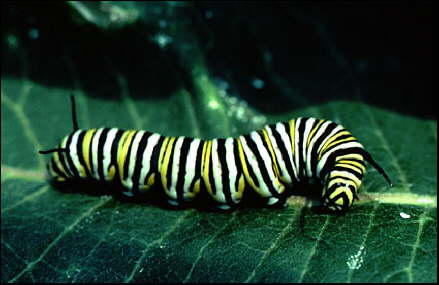
Trees are home to countless caterpillars, the larvae of moths and butterflies that dine on leaves. And searching the leaves for caterpillars are scores of hungry birds. Many, like chickadees, will look for damaged leaves, sensing that where there are holes, there are caterpillars nearby.

As defenses against birds, some caterpillars taste bad, grow spines or hairs, or bear bright “warning” colors. But in one of the little miracles of evolution, many edible caterpillar species have developed a different defensive technique. When they finish munching on a leaf, they clip it off and let it fall to the ground so it won’t give away their location to a bird on the hunt.

They don’t cover their tracks, they drop them.

Monday, June 06, 2005

Night Life

The late spring nights should be all a-blink as “lightning bugs” in romantic flight flash for mates.

Fireflies are among the few kinds of insects that everyone loves. But they may be dwindling in numbers.

Theories abound. Development is certainly removing firefly habitats, and lights may drive them away. Pesticides and pollution may be killing them, and declining food supplies may be starving them -- larva of many species feed on invertebrates that pesticides kill.

Some people want to do for fireflies what lepidopteraphiles are doing for butterflies: Create habitats that attract and feed them. Since populating a yard with the right kinds of worms and snails is a lot tougher than planting flowers, they may have a challenge ahead of them. The best thing anyone can do, though, is maintain a natural yard that is pesticide free and that welcomes the diversity of nature.

Perhaps then, lightning bugs will shed more light on our Junes.

(For more on fireflies, visit the website of Attorney Donald Ray Burger of Houston, a lawyer who is waging a campaign to bring back the fireflies that have all but disappeared from his Texas city.)

  The Jeremiah Bennett Clan: T he Days of the Desperados One morning in 1876, a Ridgefield man was sitting in a dining room of a Philadelphi...