Showing posts with label leaves. Show all posts

Friday, November 10, 2006

Abscission

As we rake, sweep and blow away the final leaves of autumn, we might wonder why they’re there – on the ground, that is, and not in the trees.

One reason was made clear here in 1987 when, on Oct. 4, a mere three inches of snow fell on leaves that were still healthy and green. The weight of snow-laded leaves felled countless limbs and trees, and knocked out power as long as four days. Broad leaves and snow just don’t mix on most large plants.

So as snow season approaches, trees shed their leaves, a process called abscission. In the fall the tree produces an “abscission layer,” a waxy substance at the base of each leaf stem. This substance, called suberin, first cuts off food and water to the leaves, resulting in the color changes.

Then, suberin’s added weight helps sever the leaves, freeing the tree of the burden and giving us our annual November exercise.

Tuesday, November 22, 2005

An older tradition

Seasons may be known by their scents, but for many of us, the smell that was autumn is gone. Thirty years ago, pollution-fighting laws banned the burning of leaves, which had been almost as much a fall family tradition as Thanksgiving.

However, the ban taught many of us that the leaf smoke's heady aroma was really a waste. Piled out back, turned occasionally, and maybe even mixed with coffee grounds and vegetable scraps, leaves become wonderfully rich food for our gardens and lawns. Composting became more common.

But the law did not ban the burning of brush, the twigs and branches that the wind and we prune from the trees. Perhaps it should have.

Brush piles have a different natural benefit. They attract birds, creating a safe haven from hawks, cats and other predators. Some birds nest in them. And as it slowly rots the brush attracts wood-eating insects that many birds relish. That pile of branches can feed and shelter scores of birds while slowly returning the vegetation to the earth.

Thus, what we used to burn can instead enrich the soil as well as feed and protect wildlife. It happens naturally, the way that was “traditional” for the eons before man.

Tuesday, November 08, 2005

Wow!

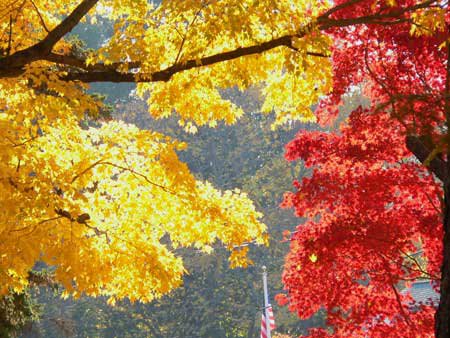
As another season of nature’s amazing treetop displays ends, we may ask “why all the color”?

Scientists know the reason leaves turn such bright colors each autumn. Several pigments, embedded in the leaf all season, have been playing second fiddle to the green chlorophyll. But now that the dying leaf no longer needs this food-producing chemical, chlorophyll fades from the scene, leaving the pigments to show off brilliant reds, yellows, oranges, and purples.

But why? Why would a tree put on such a display?

Scientists simply don’t know. As far as they can tell, a tree gains no known benefit from its autumn colors.

There is a benefit, but probably not evolutionary or measurable by scientists. The magnificence of the fall colors adds the poetic to the practical in our appreciation of these marvelous plants. Deciduous trees feed us with their fruits, shade us with their leaves, manufacture oxygen for us to breath, and hold our earth together with their roots. And just as an aside, they wow us with their brilliance each fall.

Makes it pretty tough to cut one down, doesn’t it?

  The Jeremiah Bennett Clan: T he Days of the Desperados One morning in 1876, a Ridgefield man was sitting in a dining room of a Philadelphi...